Overview
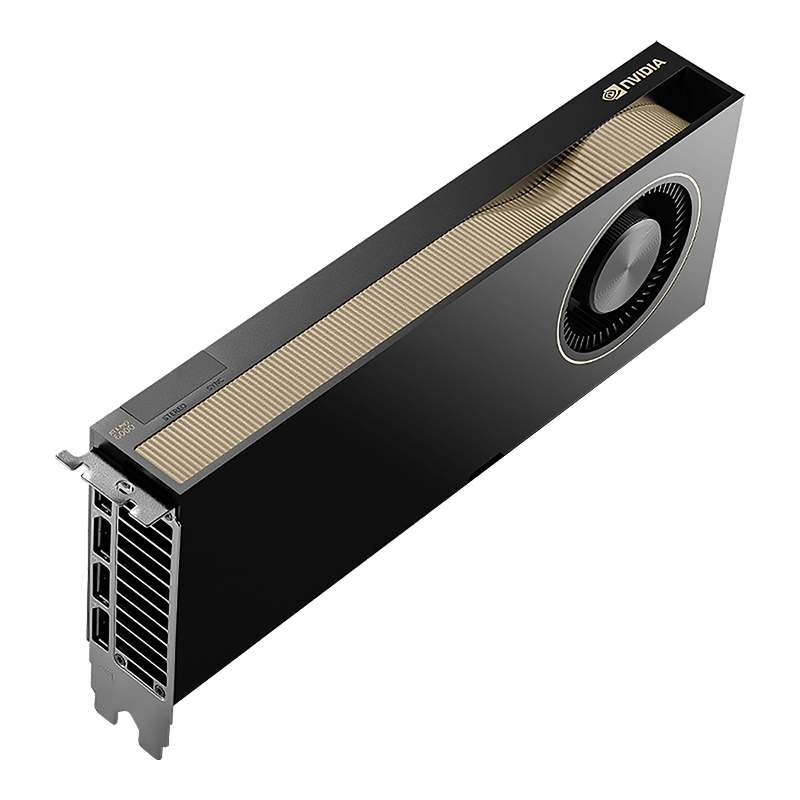
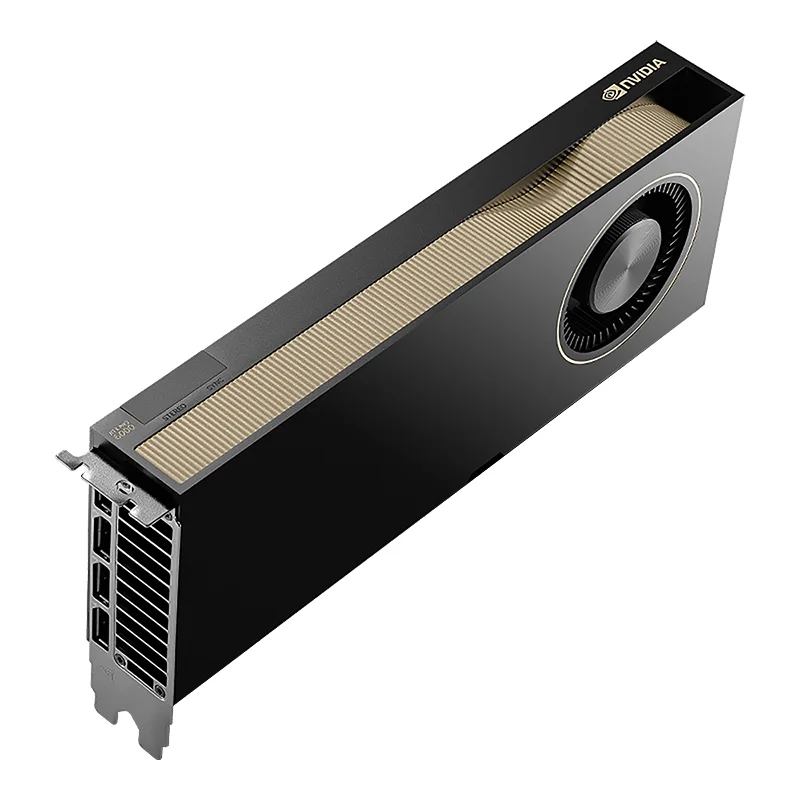
The RTX PRO 6000 Blackwell Max-Q Workstation Edition is the efficient sibling of the larger RTX PRO 6000. It uses the same GB202 chip with 24,064 CUDA cores and the same 96 GB of GDDR7 memory. The difference is in the power budget and cooling: instead of 600 W, the Max-Q is limited to 300 W, and instead of two axial fans, the card uses a blower.
NVIDIA introduced it in March 2025 together with the Workstation Edition. According to the press release, it went on sale starting in April 2025 through distributors such as PNY, and from May also in complete systems from Dell, HP, Lenovo, and others. The datasheet explicitly targets systems with multiple cards: up to four Max-Q cards can be combined in one workstation.
What it brings for AI
For local language models, graphics memory (VRAM) is crucial. As a rule of thumb, a model with 4-bit quantization, meaning heavily compressed weights, needs about 0.6 GB per billion parameters plus buffer space for the context. A 70-billion-parameter model therefore uses about 42 GB, and one in the 120-billion class about 72 GB. Both fit on a single card.
The Max-Q gets interesting in a multi-GPU setup. Four cards together provide 384 GB. That is enough for 4-bit models with several hundred billion parameters, for example 400 billion parameters at around 240 GB. Programs like vLLM or llama.cpp then split the model across the cards. The datasheet does not mention NVLink, a fast direct connection between cards. The cards exchange data over PCIe 5.0, which costs some speed when splitting across multiple cards.
Memory bandwidth is 1,792 GB/s, the same as on the 600 W version. For a 42 GB model, that works out to a theoretical ceiling of a little over 40 tokens per second, though the real-world value is lower. Because text generation depends mainly on bandwidth, the gap to the larger version should be smaller here than with pure compute load. We could not find independent measurements for this.
With MIG (Multi-Instance GPU), you can split the card into up to four isolated instances with 24 GB each. That lets multiple users or services use the same card without interfering with each other.
Specs in detail
According to NVIDIA, the Max-Q delivers 3,511 AI TOPS, 110 TFLOPS in FP32, and 333 TFLOPS of ray tracing performance. The AI TOPS apply to FP4 with sparsity, a 4-bit format where some weights are intentionally set to zero. Real models rarely reach such peak values. Compared with the 600 W version, that is about 12 percent less. DEVELOP3D sums it up well: half the power draw does not mean half the performance.
The 752 fifth-generation Tensor cores are specialized units for the matrix operations used by neural networks. The memory is connected via a 512-bit bus and has ECC, error correction against flipped bits. The card connects over PCIe 5.0 x16.
The blower, also called a radial fan, pulls in air and exhausts it out the back of the case through the slot bracket. That means waste heat does not stay inside the system. That is why several cards can sit directly next to each other. At 11.2 × 26.7 cm, the card has the usual size of a professional full-height, two-slot card. Power comes through a 16-pin connector.
Who is it for?
The Max-Q is the right choice if you are planning a system with two to four large cards. For example, to run models with several hundred billion parameters locally or to fine-tune models. DEVELOP3D expects the major workstation makers to use this version above all, and considers it the more practical choice for many companies. It is also interesting with just one card if your case does not fit the oversized 600 W version or your power supply is tight.
Limitations
Even the efficient version is not cheap. Tom's Hardware found it in the NVIDIA store in June 2026 for 13,250 US dollars, the same as the 600 W version. NVIDIA did not name an official launch price. At that price, four cards together cost over 50,000 US dollars.
A blower is usually louder under load than large axial fans. Four cards at 300 W each also require a power supply and electrical setup that can deliver 1,200 W just for the graphics cards. And the compute performance is a bit lower than the larger version. If you only use one card and have the space, the Workstation Edition offers a little more performance.
The "AI" here is not just a label: 96 GB per card and support for four cards clearly target large models.
Alternatives
- NVIDIA RTX PRO 6000 Blackwell Workstation Edition: same memory, about 12 percent more compute performance according to NVIDIA, but 600 W and more aimed at a single card.
- NVIDIA RTX PRO 5000 Blackwell 72 GB: same form factor and 300 W, 72 GB and 1,344 GB/s. Four cards total 288 GB.
- NVIDIA RTX PRO 5000 Blackwell 48 GB: same form factor, half the memory, much cheaper in stores.
This report is based on manufacturer information and published tests; we did not test the device ourselves.