Overview
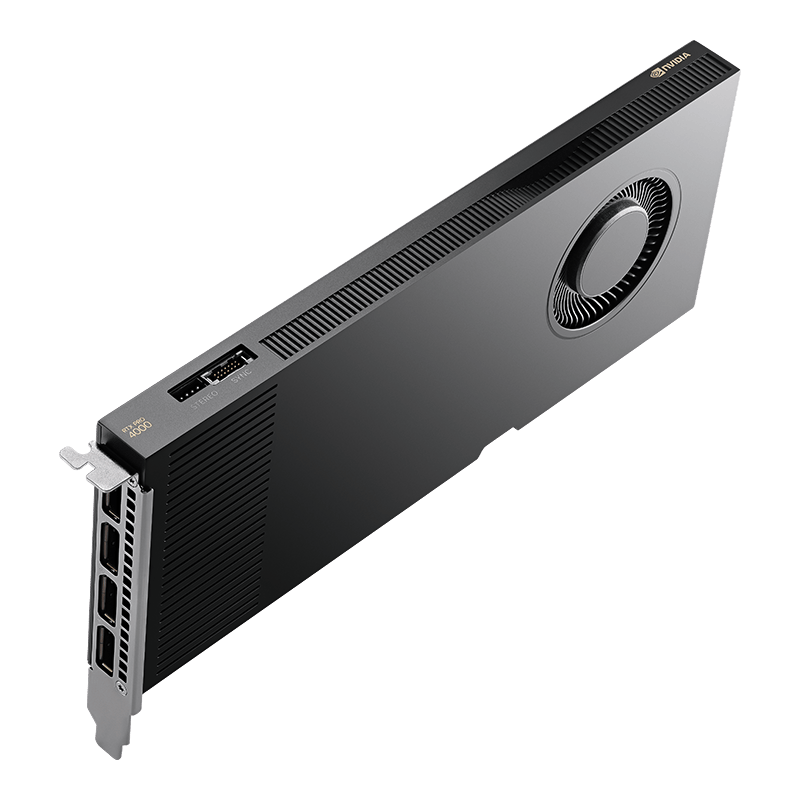
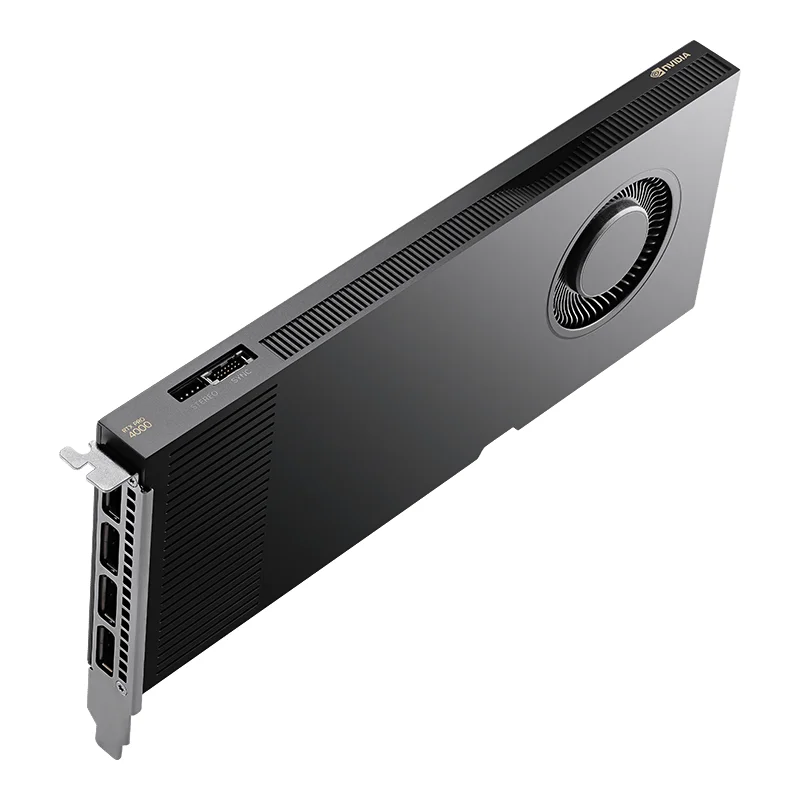
The RTX PRO 4000 Blackwell is NVIDIA's pro card in a single-slot add-in card format. Like the RTX PRO 4500, it uses the GB203 chip, here with 8,960 CUDA cores. It also comes with 24 GB of GDDR7 memory with error correction and, according to NVIDIA, 145 W power draw.
NVIDIA unveiled the card at GTC in March 2025 and, according to the press release, announced it for summer 2025 through BOXX, Dell, HP, Lenovo, and distributors. A low-profile 70 W version is available as the RTX PRO 4000 SFF.
What it brings for AI
For local language models, VRAM determines which models can run entirely on the card. As a rule of thumb, a model with 4-bit quantization, meaning heavily compressed weights, needs about 0.6 GB per billion parameters, plus buffer space for context.
A model with 14 billion parameters uses about 8.5 GB and leaves plenty of room for long texts. A model with 32 billion parameters needs about 19 GB and still fits, though with little buffer. 70 billion parameters won't fit in 24 GB.
This is where the card shines: it only takes up one slot. On a motherboard with four x16 slots side by side, four cards add up to 96 GB. That is enough for 70-billion-parameter models with room for context too. Programs like llama.cpp or vLLM split the model across the cards. NVLink, a fast direct connection between cards, is not mentioned in the datasheet. The cards exchange data over PCIe, which costs some speed when splitting the load.
Response speed mainly depends on memory bandwidth. According to NVIDIA, it is 672 GB/s. For a 19 GB model, that works out to a theoretical upper limit of around 35 tokens per second, though the real-world number is lower. Phoronix tested the card in May 2026 under Ubuntu with llama.cpp. The AMD Radeon AI PRO R9700 with 32 GB was only on par with the RTX PRO 4000 there. DEVELOP3D measures image generation with Stable Diffusion (Procyon) at 1.42 to 1.46 times the speed of the previous generation.
Specs in detail
The 280 fifth-generation Tensor cores are specialized units for the matrix math used by neural networks. They support FP4, a 4-bit number format that saves memory. NVIDIA's performance figures are inconsistent: the datasheet lists 1,178 AI TOPS and 37 TFLOPS in FP32, while the product page lists 1,290 AI TOPS and 40 TFLOPS. The AI TOPS numbers apply to FP4 with sparsity, where some weights are deliberately set to zero. Real models rarely reach such peak numbers.
The memory is connected via a 192-bit bus and has ECC, an error correction system against flipped bits. The card connects over PCIe 5.0 x16. Power figures also vary: NVIDIA lists 145 W, while PNY lists 140 W. Power comes through a 16-pin connector.
The fan, also called a blower, pushes hot air out the back through the slot bracket and out of the case. The card is only one slot wide, 11.2 cm tall, and 24.1 cm long, and PNY says it weighs 0.55 kg. NVIDIA does not list MIG, meaning splitting the card into multiple instances, for this model.
Who is it for?
The RTX PRO 4000 is a good fit if you want to comfortably run models up to about 14 billion parameters and just barely run 32-billion-parameter models. It is especially worth it if you want to fit many cards into a small space, such as four cards with a combined 96 GB and under 600 W. The single-slot design is also an advantage in compact workstations with limited room.
Limitations
In May 2026, Phoronix named a street price of around 2,199 US dollars. NVIDIA has not published an official launch price. For 24 GB, that is a lot of money if you only need one card and can do without ECC and the single-slot design.
The 672 GB/s bandwidth is moderate. A small blower on a single-slot card is usually audible under load. Multiple cards exchange data only over PCIe, and four cards require a motherboard with four properly spaced x16 slots.
The "AI" here is not just marketing fluff: 24 GB with ECC in a single-slot form factor is rare for dense multi-GPU systems.
Alternatives
- NVIDIA RTX PRO 4500 Blackwell: 32 GB and 896 GB/s, but two slots and 200 W.
- AMD Radeon AI PRO R9700: 32 GB, about as fast according to Phoronix, but with ROCm instead of CUDA and two slots.
- Sparkle Intel Arc Pro B60 24GB Blower: also 24 GB with a blower, much cheaper, but with Intel's oneAPI software.
This report is based on manufacturer data and published tests; we did not test the device ourselves.