Overview
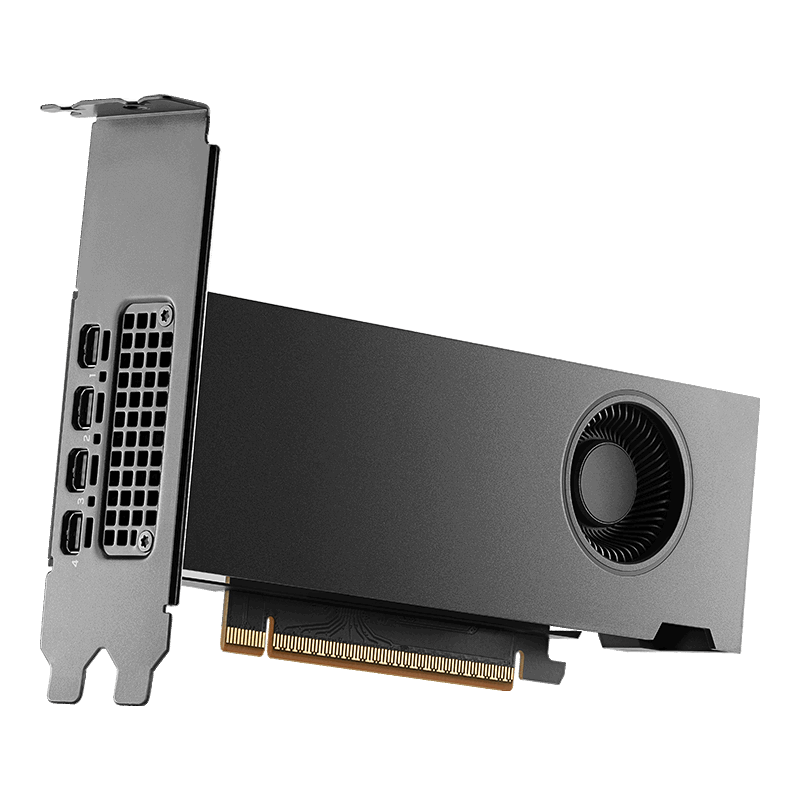
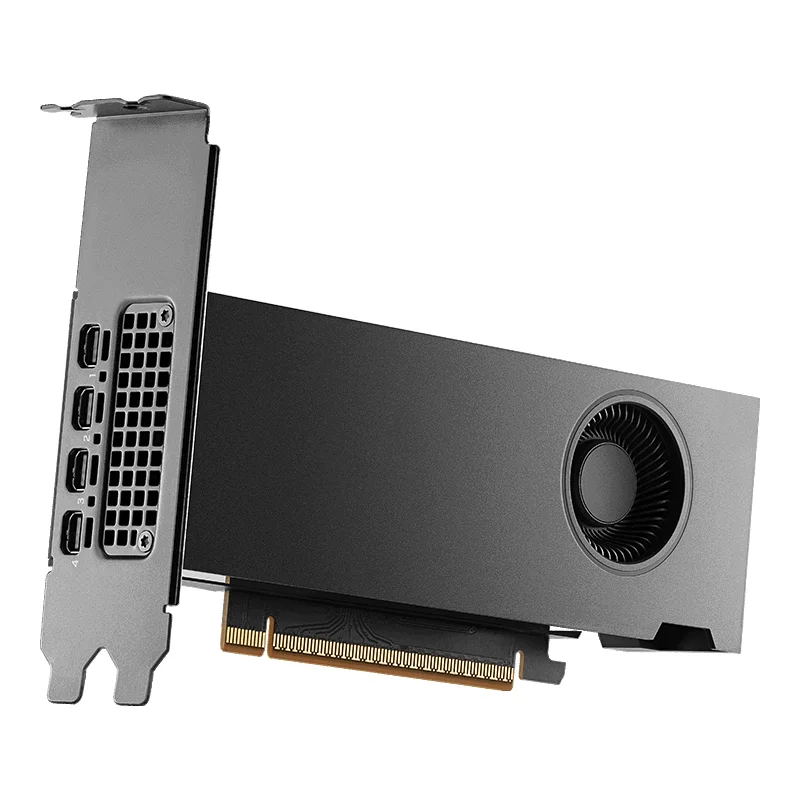
The RTX PRO 2000 Blackwell is NVIDIA’s entry-level model in its current professional lineup for workstations. It is low-profile, takes up two slots, and according to NVIDIA needs no more than 70 W. No power cable from the PSU is needed; it draws everything through the slot. According to heise, it looks like the RTX PRO 4000 SFF on the outside, just without a connector for sync cards.
Inside, according to heise, the small GB206 chip works with 4,352 CUDA cores. By core count, it sits between the GeForce RTX 5060 and RTX 5060 Ti. It also comes with 16 GB of GDDR7 memory with error correction. NVIDIA unveiled the card at SIGGRAPH in August 2025, along with the RTX PRO 4000 SFF.
What it means for AI
For local language models, the graphics memory (VRAM) determines which models can run entirely on the card. As a rule of thumb, a model with 4-bit quantization, meaning heavily compressed weights, needs about 0.6 GB per billion parameters, plus buffer space for context.
A model with 8 billion parameters uses about 5 GB, and one with 14 billion uses about 8.5 GB. Both fit with room for long texts. Models around 20 billion parameters come to about 12 GB and still fit, but then the buffer gets tight. 16 GB is not enough for 32 billion parameters.
Response speed depends mainly on memory bandwidth, because for every word generated, roughly the entire model has to be read once. According to NVIDIA, that is 288 GB/s. For an 8.5-GB model, that gives a theoretical upper limit of about 34 tokens per second; in practice, the number is lower. For a local assistant with a small model, that is perfectly fine.
Phoronix tested the card in May 2026 under Ubuntu with llama.cpp. The new Intel Arc Pro B70 with 32 GB was behind the RTX PRO 2000 there. DEVELOP3D measures 1.44 to 1.55 times the speed of the previous generation for image generation with Stable Diffusion (Procyon).
Hardware details
The 136 fifth-generation Tensor cores are specialized units for the matrix calculations used by neural networks. They support FP4, a 4-bit number format that saves memory. According to NVIDIA, the card reaches 545 AI TOPS, measured in FP4 with sparsity. In this mode, some weights are intentionally set to zero; real models rarely reach such peak values. For FP32, NVIDIA lists 17 TFLOPS.
The memory is connected to a 128-bit bus and has ECC, an error-correction feature against flipped bits. Electrically, the card uses PCIe 5.0 with eight lanes; the connector has full x16 length. It has one video encoder and one decoder, half as many as the RTX PRO 4000 SFF.
The card is 6.9 cm tall and 16.8 cm long and weighs about 300 g according to PNY. A low-profile bracket and a full-height bracket are included, along with four adapters from Mini-DisplayPort to DisplayPort. Cooling is handled by a small blower.
Who is it for?
The RTX PRO 2000 is a good fit if you want to run smaller models up to about 14 billion parameters in a compact or power-efficient system. For example, a chat assistant, OCR, transcription, or small-scale image generation. ServeTheHome also points out that many workstations use cards like this mainly for extra display outputs. For that, it is more than enough.
Limitations
16 GB is the lower limit for AI. Many current models from 20 billion parameters up either barely fit or do not fit at all. The 288 GB/s bandwidth is low, so large responses take longer.
There is no official price. At launch, heise estimated about 700 US dollars, and Phoronix mentioned a street price of around 999 US dollars in May 2026. For that money, gaming cards offer more speed, but without the low-profile design, ECC, and 70 W limit. A small fan in a low-profile case is usually audible under load.
The “AI” part is mainly a bonus here: the card is first and foremost a power-efficient professional card for graphics and displays that also handles small AI models.
Alternatives
- NVIDIA RTX PRO 4000 Blackwell SFF: same form factor and 70 W, but 24 GB and 432 GB/s. Much more expensive.
- Intel Arc Pro B50: also low-profile with 70 W and 16 GB, much cheaper, but with Intel’s oneAPI software instead of CUDA.
- NVIDIA RTX PRO 4000 Blackwell: 24 GB and 672 GB/s with one slot, but full height and 145 W.
This report is based on manufacturer specifications and published tests; we did not test the device ourselves.