Overview
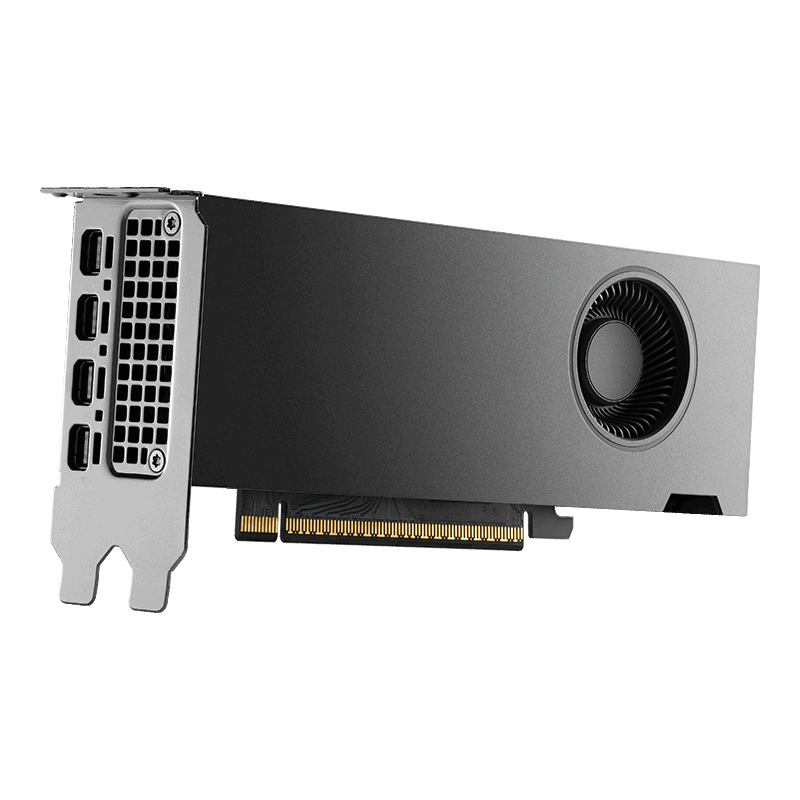
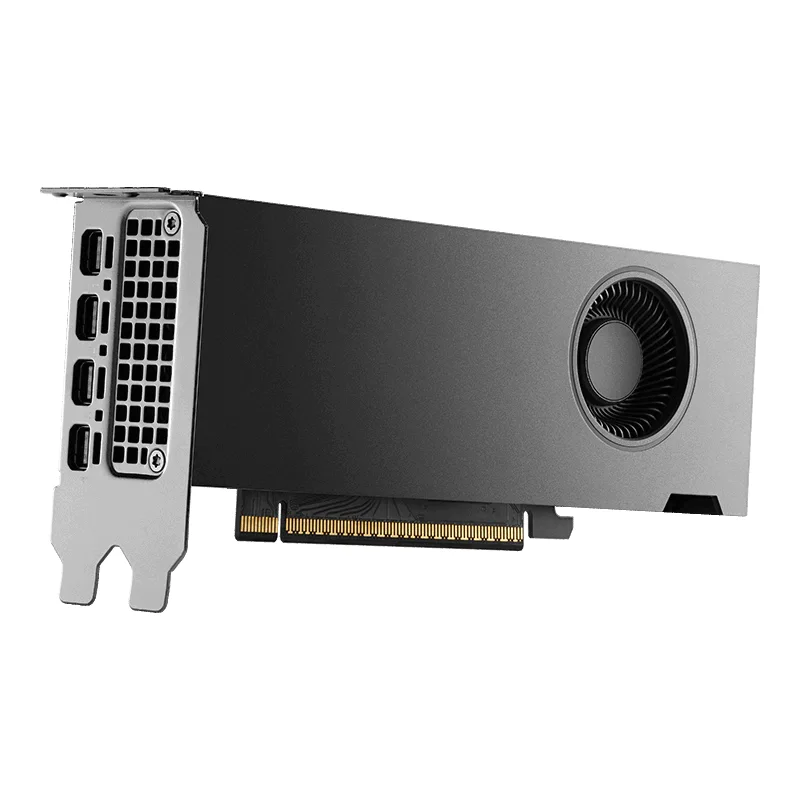
The RTX PRO 4000 Blackwell SFF Edition is a low-profile pro graphics card for compact systems. SFF stands for Small Form Factor, meaning a small physical size. The card is half-height, takes up two slots, and according to NVIDIA needs at most 70 W. No power cable from the PSU is needed; it gets everything through the slot.
Inside, according to heise, the same GB203 chip with 8,960 CUDA cores as in the full-size RTX PRO 4000 is at work. It also comes with 24 GB of GDDR7 memory with error correction. NVIDIA announced the card at SIGGRAPH in August 2025, together with the RTX PRO 2000. ServeTheHome classifies it as the successor to the RTX 4000 SFF Ada with 20 GB. The MSRP was $1,500 according to heise.
What it means for AI
For local language models, VRAM determines which models can run entirely on the card. As a rule of thumb, a model with 4-bit quantization, meaning heavily compressed weights, needs about 0.6 GB per billion parameters, plus buffer space for context.
A model with 14 billion parameters uses about 8.5 GB and still leaves plenty of room for long text. A 32-billion-parameter model needs about 19 GB and still fits, though with little headroom. 24 GB is unusually much for a 70-W card. The RTX PRO 2000 and the Intel Arc Pro B50 in the same 70-W class have 16 GB.
Speed is where the card slows down, though. Response speed depends mainly on memory bandwidth, because for each generated word, roughly the whole model has to be read once. According to NVIDIA, that is 432 GB/s. heise points out that the memory bus was reduced from 256 to 192 bit compared with the chip's full configuration, which throttles bandwidth. For a 19-GB model, that works out to a theoretical upper limit of a little over 20 tokens per second; for an 8.5-GB model, about 50. In practice, the value is lower. It's enough for reading, but for long answers from large models, you'll clearly notice the wait.
We did not find any independent AI benchmarks of the SFF version. Phoronix and DEVELOP3D tested only the full-size RTX PRO 4000.
Features in detail
The fifth-generation Tensor Cores are special units for the matrix math of neural networks. They support FP4, a 4-bit number format that saves memory. According to NVIDIA, the card delivers 770 AI TOPS, measured in FP4 with sparsity. This intentionally zeroes out some weights, and real models rarely achieve such peak numbers. For FP32, NVIDIA states 24 TFLOPS. Because of the low power budget, that is significantly less than on the full-size RTX PRO 4000.
The memory has ECC, an error-correction system that detects and fixes flipped bits. The card is connected electrically via PCIe 5.0 with eight lanes, but the edge connector has full x16 length. ServeTheHome points out that many compact workstations only have x8 slots anyway.
The card is 6.9 cm high and 16.8 cm long. According to PNY, a low-profile bracket and a full-height bracket are included, and the weight is about 340 g. Cooling is handled by a small blower. Four Mini DisplayPort outputs can drive up to four 4K monitors.
Who is it for?
The card makes sense if you want to run AI in a compact system, such as a small Dell, HP, or Lenovo workstation, a mini server, or a low-profile case. It's also interesting for an energy-efficient machine that runs around the clock: 70 W under full load is very little. Typical uses include models up to 14 billion parameters, image recognition, speech recognition, or a local office assistant.
Limitations
Bandwidth is the biggest drawback. With the same memory, the full-size RTX PRO 4000 with 672 GB/s is about 55 percent faster. According to NVIDIA, compute performance is also far lower. So for $1,500, you get a lot of memory, but not much speed.
A small fan has to work hard in low-profile cases and is usually audible. We did not find any noise measurements. For 70-billion models, the memory is not enough, and multiple SFF cards in one compact system are rarely possible.
The "AI" in the spec sheet is justified here, but with caveats: the card is aimed more at small, efficient AI workloads than at fast large models.
Alternatives
- NVIDIA RTX PRO 4000 Blackwell: same chip and memory, 672 GB/s, but full height, one slot, and 145 W.
- NVIDIA RTX PRO 2000 Blackwell: same form factor and 70 W, 16 GB and 288 GB/s, much cheaper in stores.
- Intel Arc Pro B50: also low-profile with 70 W, 16 GB, very affordable, but with Intel's oneAPI software instead of CUDA.
This report is based on manufacturer information and published tests; we did not test the device ourselves.