Overview
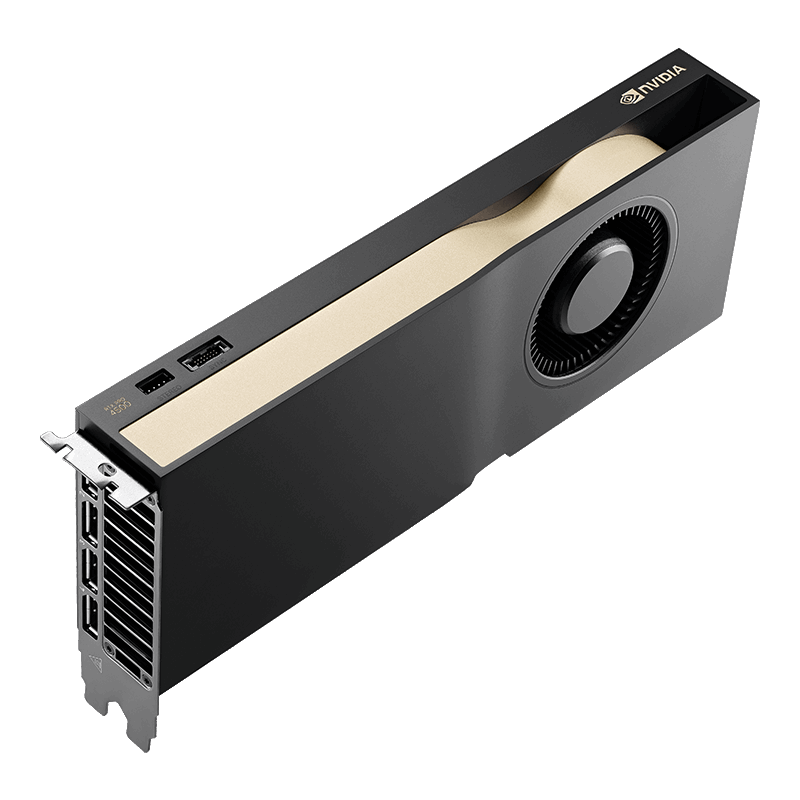
The RTX PRO 4500 Blackwell Workstation Edition is the mid-range card in NVIDIA's pro lineup. It uses the GB203 chip, the mid-sized graphics chip of the Blackwell generation, with 10,496 CUDA cores. It also comes with 32 GB of GDDR7 memory with error correction, 200 W power draw, and a blower in the classic dual-slot design. Its predecessor, the RTX 4500 Ada, had 24 GB.
NVIDIA announced the card at GTC in March 2025 and, according to its press release, said it would launch in summer 2025 through BOXX, Dell, HP, Lenovo, and distributors. In the lineup, it sits between the RTX PRO 4000 with 24 GB and the RTX PRO 5000 with 48 GB.
What it means for AI
For local language models, the graphics memory (VRAM) determines which models can run entirely on the card. As a rule of thumb, a model with 4-bit quantization, meaning heavily compressed weights, needs about 0.6 GB per billion parameters, plus buffer for context.
A model with 14 billion parameters uses about 8.5 GB, and one with 32 billion uses about 19 GB. Both fit with plenty of room for long texts. A 70-billion-parameter model needs about 42 GB and does not fit on one card. With two cards and 64 GB total, it works. Thanks to 200 W and a blower, such a two-card setup is very doable.
Response speed depends mainly on memory bandwidth, because for each generated word, roughly the entire model has to be read once. According to NVIDIA, it is 896 GB/s. For a 19 GB model, that works out to a theoretical upper limit of a little over 45 tokens per second, though real-world performance is lower.
Phoronix tested the card in May 2026 under Ubuntu with llama.cpp. In some AI tests, the RTX PRO 4500 came close to the previous top model, the RTX 6000 Ada Generation. According to Phoronix, the AMD Radeon AI PRO R9700, which also has 32 GB, could only keep up with the smaller RTX PRO 4000 in those tests.
Specs in detail
The 328 fifth-generation Tensor Cores are specialized units for the matrix calculations used by neural networks. They support FP4, a 4-bit number format that saves memory. According to NVIDIA, the card reaches 1,617 AI TOPS, measured in FP4 with sparsity. In this process, part of the weights is deliberately set to zero, so real models rarely reach these peak numbers. For FP32, NVIDIA lists 51 TFLOPS.
The memory is connected to a 256-bit bus and has ECC, an error correction feature that detects and fixes flipped bits. The card connects via PCIe 5.0 x16. Puget Systems notes that the limited power budget means lower clock speeds than the RTX PRO 5000 and 6000.
The blower, also called a radial fan, blows hot air out the back through the slot bracket and out of the case. Puget Systems therefore calls the card ideal for systems with multiple cards, but warns about higher noise under load. The card is two slots wide, 11.2 cm high, and 26.7 cm long, and weighs 1.07 kg according to PNY. Power comes through a 16-pin connector. NVIDIA does not list MIG, meaning splitting the card into multiple instances, for this model.
Who should buy it?
The RTX PRO 4500 is a good fit if you want to run language models up to about 32 billion parameters locally and care about ECC, pro drivers, and CUDA. CUDA is NVIDIA's programming interface, which most AI tools are built for first. It also fits if you are planning a system with two to four cards and want to keep power use in check. Four cards need 800 W total.
Limitations
The price is high for 32 GB. In May 2026, Phoronix listed a street price of around US$3,699. NVIDIA has not published an official launch price. The AMD Radeon AI PRO R9700 also offers 32 GB for much less money, but according to Phoronix it is slower and relies on ROCm instead of CUDA.
One card is not enough for 70-billion-parameter models. A blower is usually louder under load than large axial fans. NVLink, a fast direct connection between cards, is not listed in the specs. Multiple cards exchange data over PCIe, and splitting via MIG is not intended.
The "AI" here is more than just marketing: 32 GB with ECC at 200 W is a solid base for local models.
Alternatives
- AMD Radeon AI PRO R9700: also 32 GB, much cheaper, but slower and with ROCm instead of CUDA.
- NVIDIA RTX PRO 5000 Blackwell 48 GB: 48 GB and 1,344 GB/s, so even 70-billion-parameter models fit on one card. Much more expensive and 300 W.
- Intel Arc Pro B70: also 32 GB, cheaper, but with Intel's oneAPI software, which is less common.
This report is based on manufacturer specs and published tests; we did not test the device ourselves.