
Overview
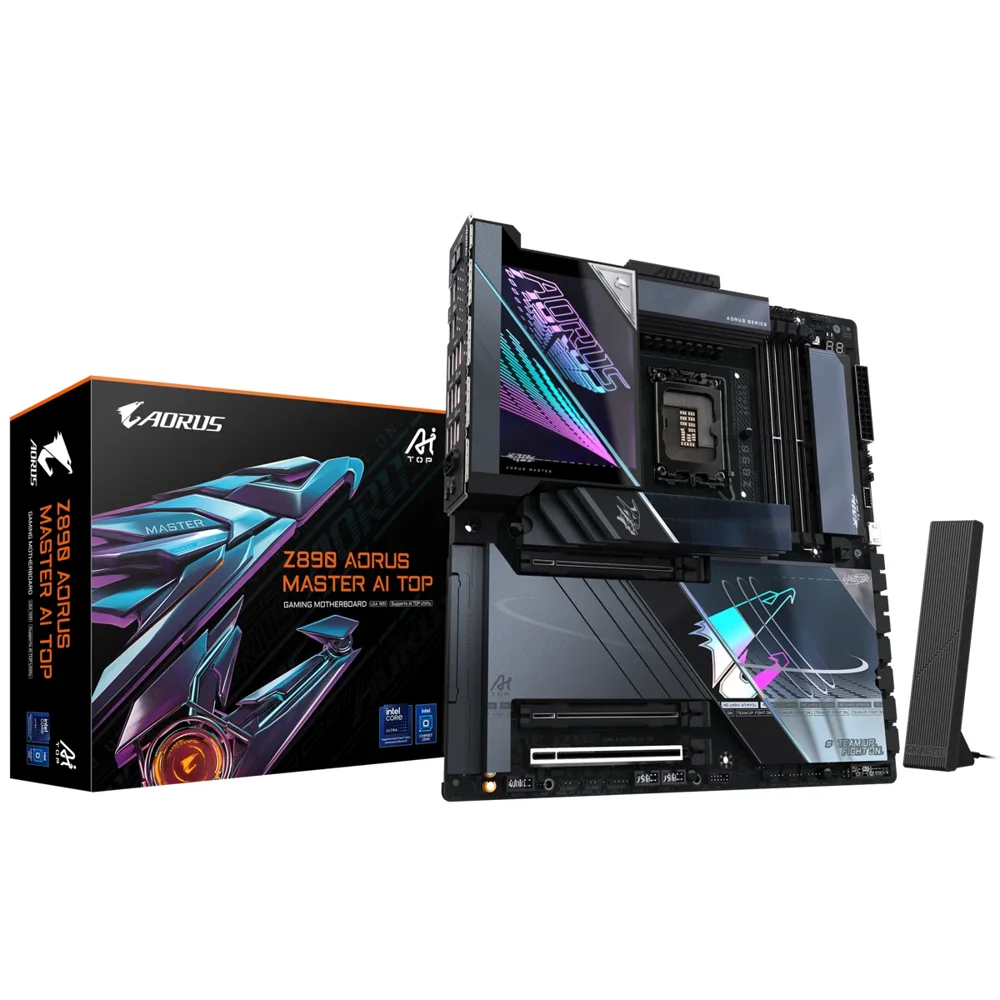
The Z890 AORUS MASTER AI TOP is a top-tier motherboard for Intel Core Ultra Series 2 desktop processors (LGA1851 socket). GIGABYTE unveiled it in October 2024 together with the Z890 AORUS XTREME AI TOP and the X870E AORUS XTREME AI TOP. The three boards form the desktop branch of the AI-TOP lineup. Above them sit the workstation models TRX50 AI TOP and W790 AI TOP.
Technically, the board is an upgraded version of the regular Z890 AORUS MASTER. It is slightly wider (E-ATX, 30.5 × 28.5 cm) and mainly adds two things: a second PCIe 5.0 slot for a second graphics card and two 10-gigabit network ports. GIGABYTE markets it with the slogan “Train your own AI on your desk,” meaning AI training on your desk.
What it brings for AI
For local language models, VRAM matters most. The board can take up to two graphics cards directly on the CPU. With one card, the top slot runs with 16 PCIe 5.0 lanes; with two cards, each gets eight. PCIe 5.0 x8 is roughly equivalent to the bandwidth of PCIe 4.0 x16. For pure model execution (inference), that is hardly a downside because the data then sits in VRAM.
A rough example: a language model with 4-bit quantization needs about 0.6 GB per billion parameters, plus buffer space for context. Two cards with 24 GB each give you 48 GB. That is just enough for a 70-billion model (around 42 GB). Two cards with 32 GB each (64 GB total) leave noticeably more room for long contexts. Tools like llama.cpp or vLLM split a model across both cards.
RAM goes up to 256 GB. That helps if you offload parts of a model into RAM, for example with large mixture-of-experts models. However, the platform only has two memory channels. With DDR5-6400, that works out to roughly 102 GB/s. That is only a fraction of a graphics card’s bandwidth, so offloaded layers run much more slowly.
The two 10GbE ports are meant for network storage (NAS) with training data or for linking multiple computers. For distributed computing across several PCs, though, 10GbE is slow compared with the connection inside one computer. There is also the AI TOP Utility software, which GIGABYTE uses to simplify fine-tuning open language models. According to GIGABYTE, the AI-TOP concept supports local training of models with up to 236 billion parameters. That figure applies to complete AI-TOP systems with suitable hardware, not to this board alone.
Features in detail
According to GIGABYTE, the power delivery uses 20+1+2 phases with 110 A power stages. That is more than enough for Core Ultra 200S processors. Profesional Review measured a maximum of 51 °C at the VRM sensor under 250 W sustained CPU load.
For SSDs, there are four M.2 slots: one PCIe 5.0 and one PCIe 4.0 from the CPU, plus two more PCIe 4.0 slots from the chipset. One of the chipset slots also accepts SATA SSDs. There are also four SATA ports. Important: the manual does not mention shared lanes between the M.2 slots and the graphics-card slots, and Profesional Review notes that all four M.2 slots can be used without restrictions. The third long slot is connected to the chipset and has only four PCIe 4.0 lanes. It is suitable for a network or storage card, not for a third fast graphics card.
On the back, you get ten USB-A ports at 10 Gb/s and two Thunderbolt 4 ports (USB4, 40 Gb/s), which can also output video. Unlike the Xtreme model, there is no Thunderbolt 5 here. Wireless is handled by Wi-Fi 7 with Bluetooth 5.4. For troubleshooting, there is a POST code display, status LEDs, and onboard power and reset buttons. Remote management via BMC, as found on server boards, is not included.
Who is it for?
This board makes sense if you are building a powerful Intel desktop PC and want to add a second graphics card later. Anyone who needs fast connections to a NAS or a second computer will also benefit from the dual 10GbE. Without those two points, the regular Z890 AORUS MASTER gives you almost the same performance for less money.
Limitations
The “AI” in the name is largely marketing. The platform remains a desktop platform: two memory channels, at most 256 GB RAM, and at most two graphics cards with eight lanes each. A workstation with Threadripper or Xeon offers far more lanes and memory channels. Profesional Review lists the high premium over the regular MASTER, the barely expanded internal features, the lack of an optical audio output, and the E-ATX form factor that does not fit every case as weaknesses. The reviewer cites a price around 740 euros, recently over 850 euros. Two large graphics cards placed right next to each other also need a case with good airflow and a strong power supply.
Alternatives
- GIGABYTE Z890 AORUS XTREME AI TOP: the larger sibling model with Thunderbolt 5, otherwise also limited to two graphics cards.
- GIGABYTE X870E AORUS XTREME AI TOP: the AMD Ryzen (AM5) equivalent, also with two PCIe 5.0 slots and dual 10GbE.
- GIGABYTE TRX50 AI TOP: if you really need more than two graphics cards and lots of memory. Four fully connected slots and up to 2 TB RAM, but much more expensive.
This report is based on manufacturer information and published tests; we did not test the device ourselves.