Overview
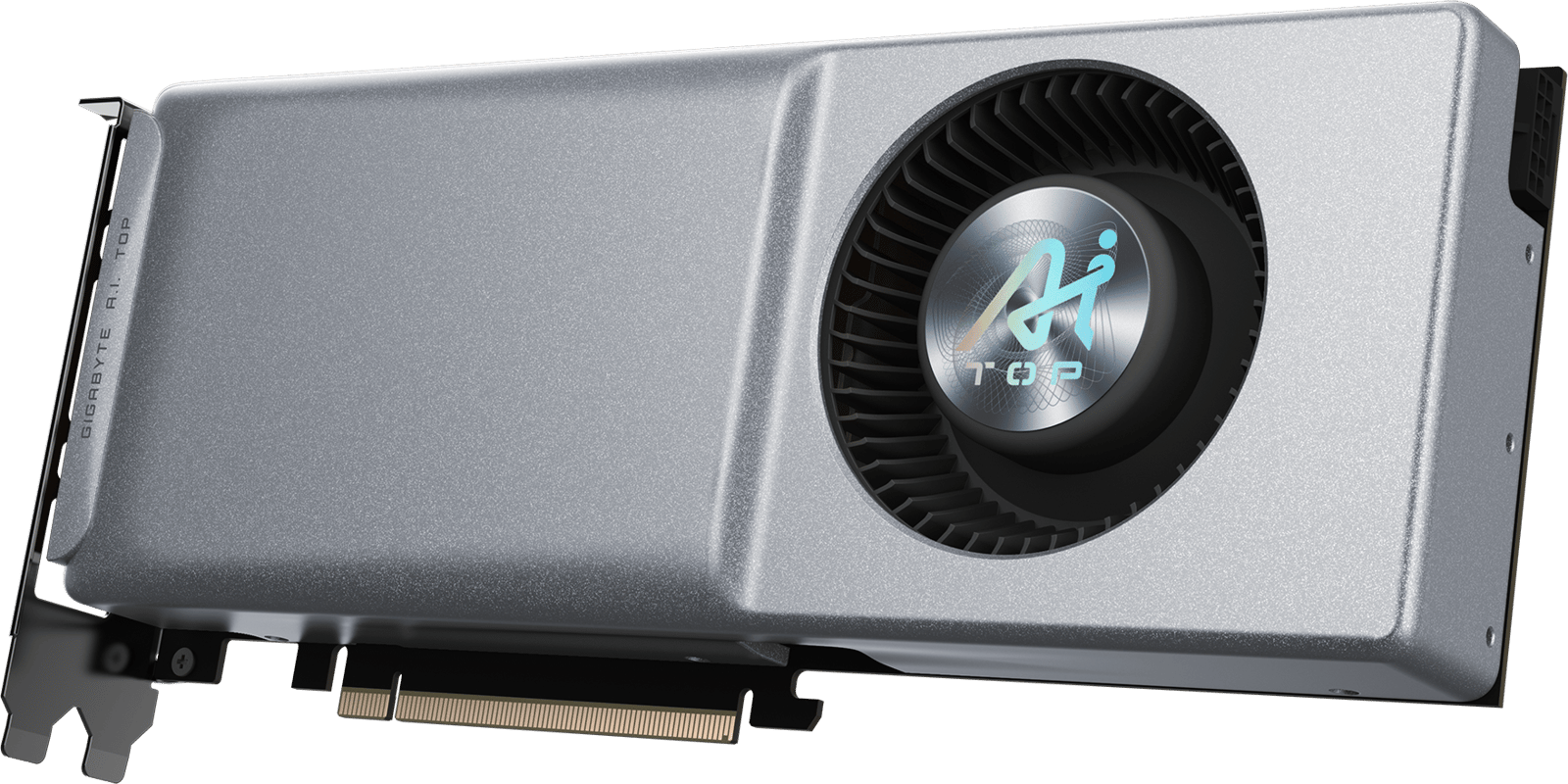
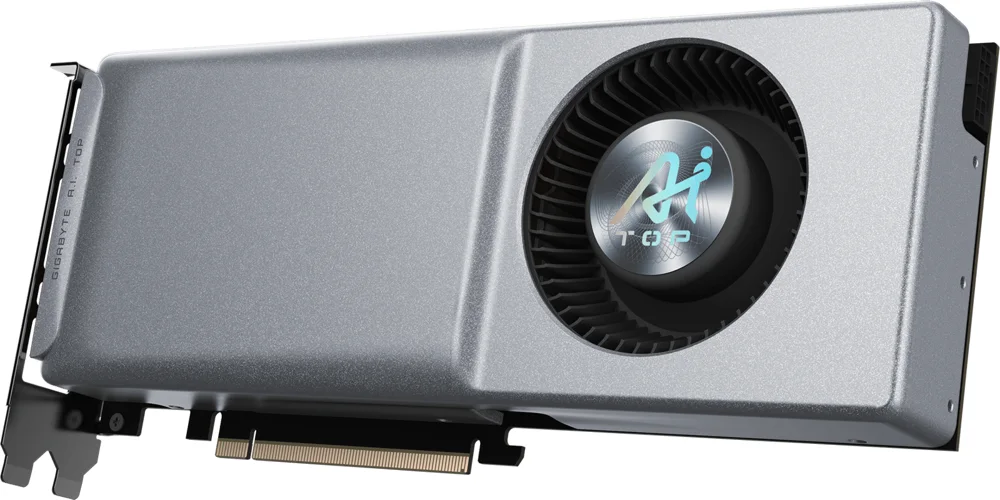
The GIGABYTE GeForce RTX 4070 Ti SUPER AI TOP 16G is a completely normal RTX 4070 Ti SUPER with a special cooler. Instead of the usual two or three large fans, it has a single blower at the end of the card that pushes warm air out the back of the case. GIGABYTE introduced the card at Computex in June 2024 as part of its AI TOP lineup. The idea: up to four cards packed closely together in one system. Notebookcheck says the card otherwise does not differ from the regular model. The Swedish retailer Inet now lists it as discontinued.
What it brings for AI
With 16 GB of VRAM, the card is rather small for AI. As a rough rule of thumb, a language model with 4-bit quantization needs about 0.6 GB per billion parameters plus some headroom. Models with 7 to 14 billion parameters fit well, and models with around 20 billion still fit narrowly. For models with 32 billion parameters, which need around 19 GB, one card is not enough.
This is exactly where GIGABYTE comes in. Four cards together have 64 GB. That also makes it possible to run models with 70 billion parameters in 4-bit form, split across all the cards. The catch: data between the cards runs over PCIe 4.0. NVLink, a fast direct connection between cards, is not available on the RTX 4070 Ti SUPER. For simply running language models, that is usually manageable, but during training the slower connection matters more.
Memory bandwidth is 672 GB/s. It determines how fast a language model can generate tokens, meaning word pieces. For a 14-billion model at around 8.4 GB, that works out to a theoretical upper limit of about 80 tokens per second. In real use, the value is lower, but still fast enough for everyday work.
Specs in detail
According to NVIDIA, the AD103 chip has 8448 CUDA cores and reaches 706 AI TOPS. That is the performance of the Tensor cores, special compute units for AI. NVIDIA does not say which precision this value applies to. GIGABYTE lists 264 fourth-generation Tensor cores and a clock speed of 2610 MHz.
The memory is 16 GB of GDDR6X with a 256-bit bus width. According to NVIDIA, the card draws 285 W. Power comes through a 16-pin connector, and an adapter to two 8-pin cables is included. GIGABYTE recommends a 750 W power supply. The card is 260 mm long and takes up two slots. According to GIGABYTE, the cooler is made of copper with a metal frame, plus a metal backplate. Outputs are three DisplayPort 1.4a and one HDMI 2.1a.
The big advantage over AMD and Intel cards is the software. Almost every AI program runs first and best with NVIDIA's CUDA, on Windows as well as Linux. GIGABYTE also includes its AI TOP Utility for fine-tuning models.
Who is it for?
The card makes sense if you want to run several NVIDIA cards in one system and care about easy CUDA software. As a single card, it is hardly worth it. A normal RTX 4070 Ti SUPER with an open cooler is just as fast and usually quieter.
Limitations
The “AI TOP” label is mostly marketing here. Chip, memory, and performance are identical to any other RTX 4070 Ti SUPER; only the cooler is different. 16 GB per card is not much for AI. Four cards together draw more than 1,100 W and still only provide 64 GB, the same as two 32 GB cards. Blower coolers are loud under load. The card belongs to the older RTX 40 generation, is discontinued according to Inet, and is now hard to find. We could not find an MSRP for GIGABYTE's version.
Alternatives
- GIGABYTE Radeon AI PRO R9700 AI TOP 32G: twice the memory, also with a blower, but AMD software instead of CUDA.
- NVIDIA RTX PRO 4000 Blackwell: more memory, slimmer and more power efficient, with CUDA.
- Sparkle Intel Arc Pro B60 Blower: 24 GB with a blower cooler, but with Intel's software instead of CUDA.
This report is based on manufacturer information and published tests; we did not test the device ourselves.