
Overview
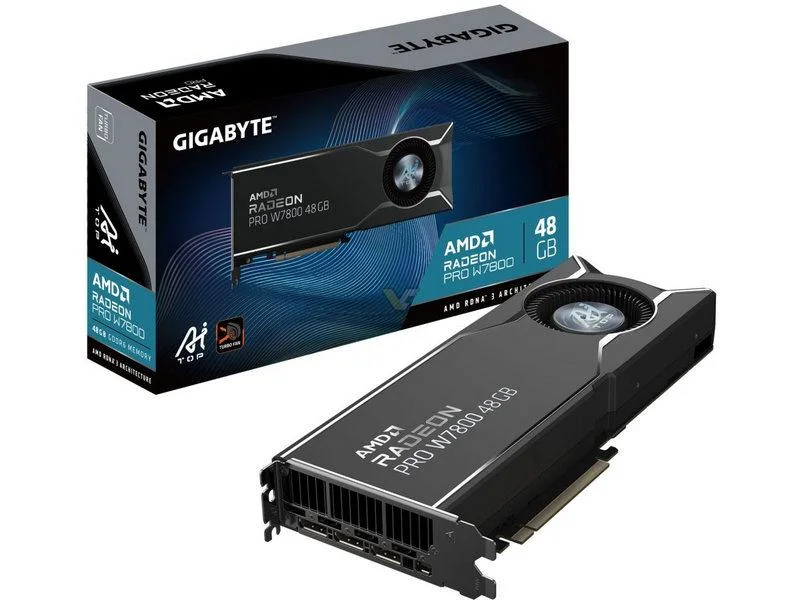
The GIGABYTE Radeon PRO W7800 AI TOP 48G is GIGABYTE’s version of the AMD Radeon PRO W7800 48GB. It uses the same Navi 31 chip from the RDNA 3 generation as the larger W7900, but with fewer active compute units. AMD increased the memory in this version: 48 instead of 32 GB, connected with 384 instead of 256 bits. That gives it the same amount of memory and bandwidth as the W7900. GIGABYTE introduced the card in November 2024. It complements the W7800 AI TOP with 32 GB, which was presented in June 2024. So there is room for confusion: when buying, watch for “48G” in the name.
What it brings for AI
For language models, memory matters more than compute power. As a rough rule of thumb, a model with 4-bit quantization needs about 0.6 GB per billion parameters plus some headroom. A model with 70 billion parameters therefore uses about 42 GB and fits on the card, though with little room for long context. Models up to about 32 billion parameters even run with 8-bit precision.
How fast a language model generates tokens depends mainly on memory bandwidth. A token is roughly a word part. With 864 GB/s, the theoretical upper limit for a 42 GB model is about 20 tokens per second. In practice, the value is lower. Because the bandwidth is the same as on the W7900, the W7800 should not lag far behind when it comes to pure text generation. For processing long inputs and for training, however, compute power matters, and the W7900 has about one third more.
The card is well suited for multi-card systems. GIGABYTE says that four cards together provide 192 GB of graphics memory. The blower cooler exhausts air out the back of the case, and the card takes up only two slots.
Detailed specs
According to GIGABYTE, it has 4480 stream processors in 70 compute units, plus 140 AI accelerators and 70 raytracing units. GIGABYTE lists 45.2 TFLOPS at FP32 and 90.5 TFLOPS at FP16. FP16 is the 16-bit compute precision commonly used for AI. The memory has ECC, so it can detect and correct single-bit errors by itself.
According to GIGABYTE, the card draws up to 281 W and is powered through two 8-pin connectors. GIGABYTE recommends a 700 W power supply. It is 293 mm long and weighs 1.25 kg. For monitors, it has three DisplayPort 2.1 outputs and one Mini-DisplayPort, but no HDMI. The card connects via PCIe 4.0 x16. GIGABYTE also mentions a vapor chamber, a dual-ball-bearing fan, and a metal backplate.
On the software side, the W7800 is one of the cards supported by AMD with ROCm, AMD’s counterpart to NVIDIA’s CUDA. AMD offers Linux driver packages with ROCm for the 48 GB version. It also comes with GIGABYTE’s AI TOP Utility for fine-tuning models.
Who is it for?
This card makes sense if you need 48 GB of graphics memory but do not want to pay the extra cost for the W7900’s full compute performance. For simply running language models, that is often the more sensible choice.
Limitations
GIGABYTE did not name a price at launch. Professional cards with 48 GB cost significantly more than gaming cards. RDNA 3 is an older generation and does not support FP8, which newer cards like the R9700 can do. ROCm works best under Linux; many tools appear for CUDA first. Blower coolers are audible under load. The “AI TOP” label is mostly branding. According to Tom's Hardware, GIGABYTE’s AI TOP professional cards largely follow AMD’s reference design.
Alternatives
- GIGABYTE Radeon PRO W7900 Dual Slot AI TOP 48G: same memory, more compute power, slightly higher power draw and price.
- GIGABYTE Radeon AI PRO R9700 AI TOP 32G: newer architecture with FP8 and PCIe 5.0, but only 32 GB.
- Maxsun Intel Arc Pro B60 Dual 48G: 48 GB on one card, but split across two graphics chips with 24 GB each.
This report is based on manufacturer information and published tests; we did not test the device ourselves.
