
Overview
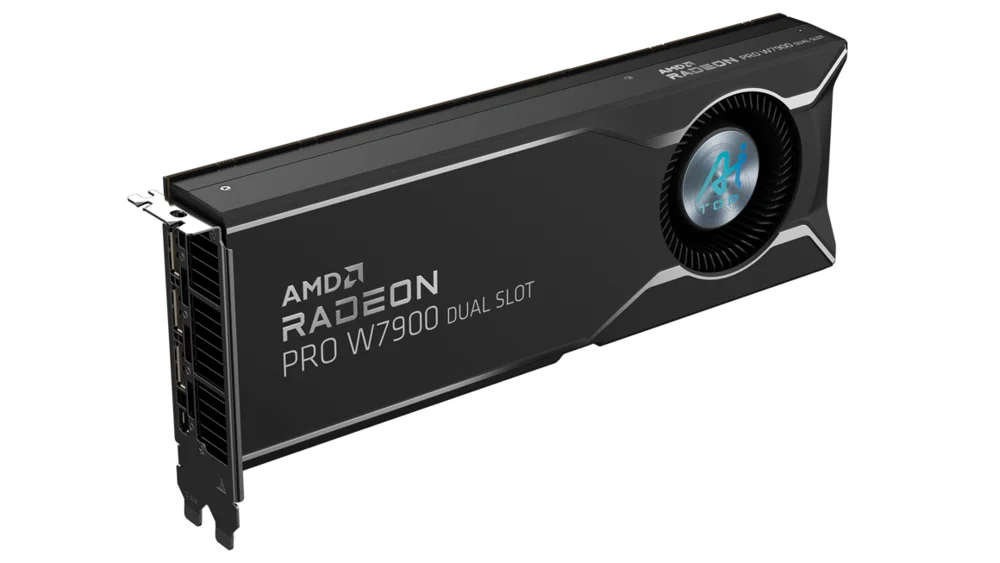
The GIGABYTE Radeon PRO W7900 Dual Slot AI TOP 48G is GIGABYTE's version of the AMD Radeon PRO W7900 Dual Slot. It's a professional workstation card with the large Navi 31 chip from the RDNA 3 generation and 48 GB of VRAM with error correction. AMD originally built the W7900 with a cooler that took up three slots. The dual-slot version only needs two slots. GIGABYTE showed its version in June 2024 at Computex as part of the new AI TOP lineup. According to Tom's Hardware, it's almost a copy of AMD's reference design, just with different branding and an AI TOP sticker on the fan.
What it means for AI
48 GB of VRAM is a lot for local language models. As a rough rule, a model with 4-bit quantization needs about 0.6 GB per billion parameters plus some buffer. A model with 70 billion parameters uses about 42 GB this way and fits on a single card, though with little room for a long context. Models up to about 32 billion parameters even run with 8-bit precision.
Memory bandwidth is 864 GB/s. It determines how fast a language model generates tokens, meaning word pieces. For a 70-billion model using 42 GB, that works out to a theoretical limit of about 20 tokens per second. In practice the number is lower, but that's often still enough for smooth reading.
The design is made for multiple cards. The blower cooler exhausts air out the back of the case, and the card only takes up two slots. Four cards give you 192 GB of VRAM. That also fits very large models with more than 200 billion parameters in 4-bit form.
Specs in detail
According to GIGABYTE, the card has 6144 stream processors in 96 compute units, 192 AI accelerators, and 96 ray tracing units. Tom's Hardware lists 61.3 TFLOPS for FP32, while GIGABYTE gives 122.64 TFLOPS for FP16. FP16 is 16-bit compute precision, which is often used in AI. The memory has ECC. That means it can detect and correct single-bit errors on its own. During long training runs, that can prevent crashes or wrong results.
According to GIGABYTE, the card draws up to 295 W and is powered by two standard 8-pin connectors. GIGABYTE recommends a 750 W power supply. It is 293 mm long. Instead of HDMI, it has three DisplayPort 2.1 outputs and one Mini-DisplayPort. It connects through PCIe 4.0 x16, not PCIe 5.0.
On the software side, AMD relies on ROCm, and the W7900 Dual Slot came out together with ROCm 6.1. ROCm is AMD's answer to NVIDIA's CUDA, meaning the software layer that lets PyTorch and other AI programs use the graphics card. GIGABYTE includes its AI TOP Utility for fine-tuning models.
Who is it for?
This card makes sense if you want to run 70-billion-parameter models on a single card or plan a workstation with multiple cards and need a lot of memory per slot. It's also a good fit if you want ECC memory for long compute runs.
Limitations
The price is high. AMD listed the W7900 Dual Slot at US$3,499, and we couldn't find a separate price for GIGABYTE's version. RDNA 3 is now an older generation. The newer Radeon AI PRO R9700 has less memory but supports newer AI formats like FP8. ROCm runs best on Linux, and many tools still appear for CUDA first. Blower coolers are clearly audible under full load. The "AI TOP" in the name is mostly marketing. According to Tom's Hardware, the hardware is largely AMD's own card.
Alternatives
- GIGABYTE Radeon PRO W7800 AI TOP 48G: same amount of memory and same bandwidth, fewer compute units, a bit more efficient.
- GIGABYTE Radeon AI PRO R9700 AI TOP 32G: newer RDNA 4 architecture with PCIe 5.0, but only 32 GB and 640 GB/s.
- NVIDIA RTX PRO 5000 Blackwell: also 48 GB, but with CUDA.
This report is based on manufacturer information and published tests; we did not test the device ourselves.
