
Overview
The Intel Arc Pro B70 is Intel’s largest Battlemage-generation graphics card so far. Intel introduced it on March 25, 2026, together with the smaller B65. The B70 uses the large BMG-G31 chip, which had not appeared in any gaming card up to that point. Intel is launching it first for AI and workstations.
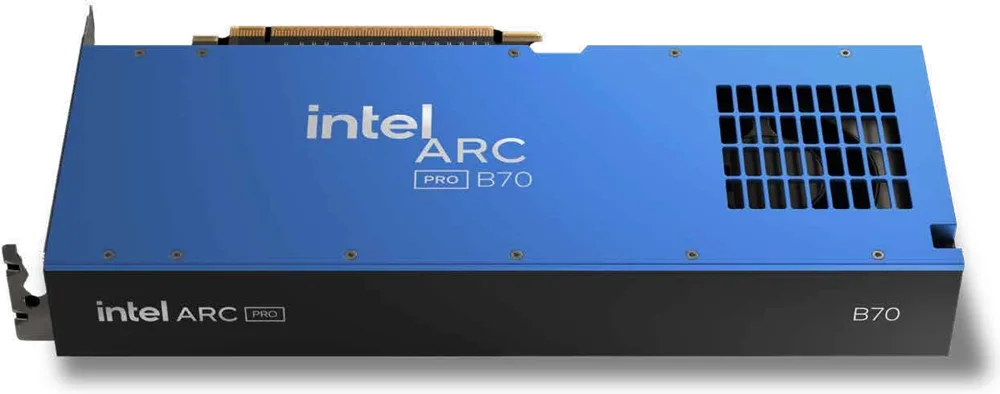
Intel sells its own version for US$949, while partners like ASRock, Gunnir, and Sparkle are building their own models. Intel’s card is two slots thick, 267 mm long, and has a blower fan that pushes exhaust out the back of the case. That makes it suited for systems with multiple cards. In Intel’s lineup, it sits at the top, above the B65, B60, and B50.
What it means for AI
32 GB of VRAM is the key feature. As a rule of thumb, a 4-bit reduced (quantized) language model needs about 0.6 GB per billion parameters, plus buffer for context. In 32 GB, that comfortably fits models with 30 to 35 billion parameters, even with longer context. At 8-bit, it supports models up to about 27 billion parameters.
The 608 GB/s bandwidth is one third higher than the B60. That directly improves token generation speed, because the model has to be read once for every token. Early measurements show this: Tester PMZFX reports on GitHub with llama.cpp 82.6 tokens/s for Llama 3.1 8B in 4-bit. For the MoE model Qwen 3.6-35B-A3B in 4-bit, it reaches 54.7 tokens/s, and for the dense Qwen 3.5-27B in 8-bit, 15.3 tokens/s. MoE means Mixture of Experts: only part of the model is computed per token, which makes it faster.
Puget Systems tested four B70s with vLLM and uncompressed FP16 models. One card gets 35 tokens/s with Llama 3.1 8B for one user and 256 tokens/s with eight users. Four cards together run Qwen3.6-27B at 13 tokens/s for one user. According to Puget, an RTX 5090 is four to five times faster per card, but it also costs several times more.
StorageReview pitted four B70s against an RTX PRO 6000 and a DGX Spark. With gpt-oss-120b, the four B70s reached about 75 percent of the RTX PRO 6000’s throughput and a little over three times the DGX Spark.
Hardware details
The BMG-G31 chip has 32 Xe cores with 256 XMX units. XMX are matrix compute units for AI, comparable to NVIDIA’s Tensor Cores. Intel lists 367 TOPS at INT8 and 22.94 TFLOPS at FP32. In compute performance and TOPS, that is almost twice as much as the B60 and B65.
Unlike the B60, the B70 uses all 16 PCIe 5.0 lanes. That helps when loading large models and when exchanging data between multiple cards. The memory has ECC. ECC detects and corrects memory errors, which is a plus during long compute runs.
Intel’s card needs 230 W through a single 8-pin connector. Partners may choose between 160 and 290 W, and Sparkle lists 330 W for its blower version. igor'sLAB measured the Intel card under sustained load: 50.6 dB sound pressure, with the fan spinning at just under 2,000 RPM. The hottest point on the chip was 75 to 76 °C, and the memory was 78 to 80 °C. Under compute load, the card ran at 2,100 to 2,150 MHz.
Since driver 32.0.101.8629 from April 2026, Intel officially supports the B70 for games as well.
Who is it for?
The B70 makes sense if you want 32 GB of VRAM at a much lower price than NVIDIA’s pro cards. It is well suited for models up to around 35 billion parameters on one card and for systems with two to four cards. Four B70s give you 128 GB for about $3,800 list price, which StorageReview highlights as a strength. If you work under Linux with vLLM or llama.cpp and don’t mind some tinkering, you get a lot of memory per dollar.
Limitations
Software is the biggest weakness. StorageReview calls Intel’s vLLM branch (LLM Scaler) beta quality, with a limited model selection and some missing quantizations. Puget reports that models were only blocked in vLLM with bfloat16. Many programs are written for NVIDIA’s CUDA; on Intel, you need oneAPI, SYCL, or Vulkan.
The price has gone up: StorageReview found the card for over $1,100 at the time of testing, and Puget estimates about $1,110.
A blower cooler is audible by design. And per card, the B70 is clearly slower than an RTX 5090 for language models.
Alternatives
- Intel Arc Pro B65: also 32 GB and 608 GB/s, but with 20 instead of 32 Xe cores and only available through partners.
- Maxsun Arc Pro B60 Dual 48G Turbo: more memory per slot, but two 24 GB cards and requires bifurcation.
- Sparkle Arc Pro B60 24GB Blower: cheaper entry with 24 GB, for smaller models.
This report is based on manufacturer specs and published tests; we did not test the device ourselves.