
Overview
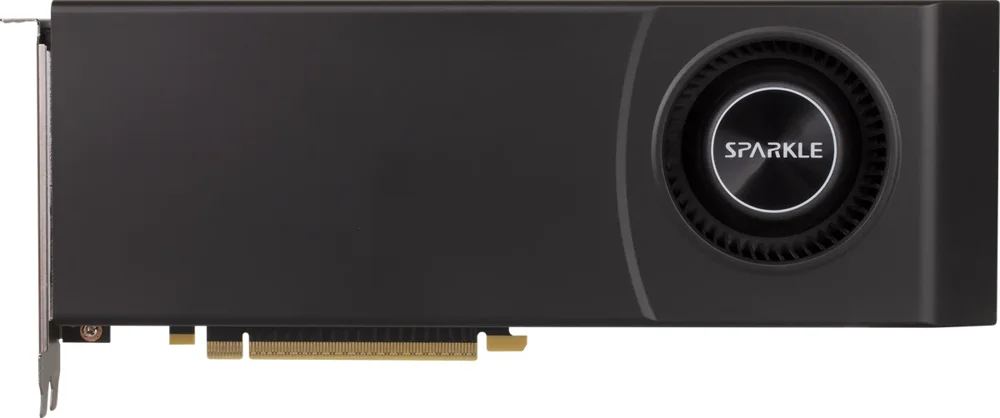
The Intel Arc Pro B65 is the smaller sister of the B70. Intel introduced both on March 25, 2026. The B65 went on sale in mid-April 2026, and only as a partner card. There is no Intel-branded version. Sparkle, for example, offers a blower and a passive version.
Technically, the B65 is a mix: it uses the large BMG-G31 chip from the B70, but with only 20 active Xe cores. That gives it the same number of compute units as the B60. From the large chip, however, it inherits the 256-bit memory bus, 32 GB VRAM, and full PCIe 5.0 x16 connectivity. According to Intel, AEC Magazine says the B65 is just as fast as the B60 in many applications, but has more memory and bandwidth.
What it means for AI
For local language models, that is an interesting combination. When generating text, what matters most is how much memory the card has and how fast it can read it. Compute performance is often secondary.
As a rule of thumb, a 4-bit reduced (quantized) language model needs about 0.6 GB per billion parameters, plus buffer space for the context. In 32 GB, that comfortably fits models with 30 to 35 billion parameters, even with longer context. At 8-bit, it is enough for models up to about 27 billion parameters.
The 608 GB/s bandwidth is just as high as on the B70 and one third higher than on the B60. For each new token, the card has to read the model once end to end. A 20 GB model works out to at most about 30 tokens per second, and less in real use. For one user and one model, the B65 therefore should not be far behind the B70. It is weaker when processing long prompts (prefill) and with many simultaneous requests, because that is where compute performance matters. According to Intel, the B70 has 367 instead of 197 TOPS. We did not find independent AI benchmarks for the B65.
Intel promotes multi-GPU operation under Linux. Two B65 cards give you 64 GB, four cards 128 GB.
Hardware details
The chip has 20 Xe cores with 160 XMX units. XMX are matrix compute engines for AI, comparable to NVIDIA's Tensor cores. Intel lists a 2,400 MHz clock, 12.28 TFLOPS at FP32, and 197 TOPS at INT8. These are exactly the same values as the B60.
The difference is memory: 32 instead of 24 GB, 256 instead of 192 bit, 608 instead of 456 GB/s. It also comes with PCIe 5.0 with 16 instead of 8 lanes. That speeds up loading large models and data exchange between multiple cards.
Intel lists 200 W as the reference. Connector, cooler, and dimensions are up to the partners. According to the datasheet, Sparkle's blower version draws up to 240 W over a 12V-2x6 connector, is 289 mm long, two slots thick, and has four DisplayPort 2.1 outputs. According to Sparkle, it supports SR-IOV with up to seven virtual GPUs. That lets you split the card across multiple virtual machines.
Since driver 32.0.101.8629 from April 2026, the B65 is officially approved for gaming as well. There are also professional drivers with certifications for CAD programs.
Who is it for?
The B65 makes sense if you want 32 GB VRAM but do not care as much about the full compute performance of the B70. A typical setup is a home server where one user runs a mid-size model with long context. It is also interesting if you need multiple virtual machines with GPU access.
Limitations
Intel does not name an official price, and igor'sLAB found no list price at launch. Whether the B65 is noticeably cheaper than the B70 in stores depends on the partner. If the gap is small, the B70 is usually the better choice.
Software remains the main issue with Intel. Many AI programs are built around NVIDIA's CUDA. With Intel, you need oneAPI, SYCL, Vulkan, or Intel's own vLLM containers. In StorageReview's B70 test, Intel's vLLM branch is still described as beta quality.
Features, noise, and power use vary depending on the partner card. We have not found any independent tests of the B65 yet.
Alternatives
- Intel Arc Pro B70: same memory, but 32 Xe cores and almost double the AI performance, as an Intel card for 949 US-Dollar.
- Sparkle Arc Pro B60 24GB Blower: 8 GB less and slower memory, but usually cheaper.
- Maxsun Arc Pro B60 Dual 48G Turbo: more memory per slot, but split across two chips.
This report is based on manufacturer information and published tests; we did not test the device ourselves.
