Overview
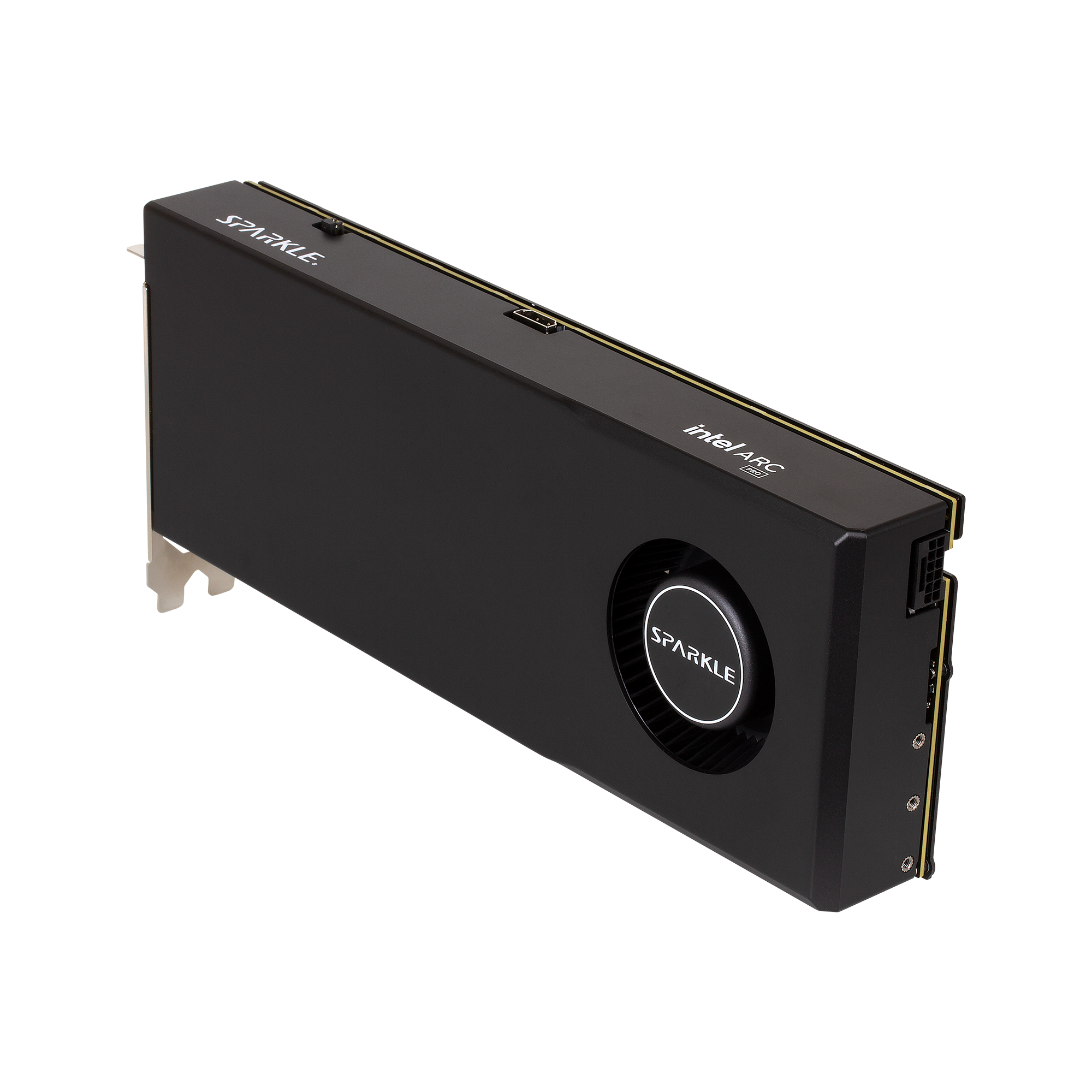
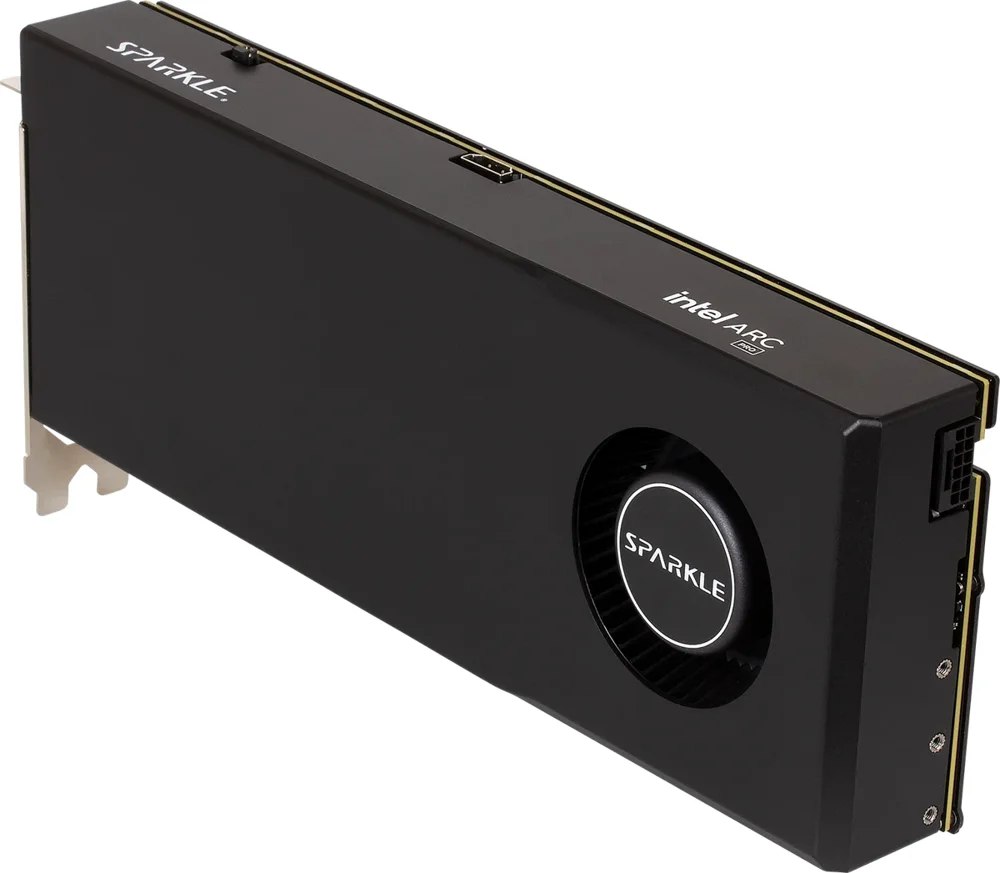
The Sparkle Arc Pro B60 Dual 48GB Blower is Sparkle’s version of a dual-card design: two Arc Pro B60 graphics chips with 24 GB each on one board. Sparkle announced a Dual B60 at Computex 2025, back then with “TBD” for many specs. Sparkle only put the final datasheet with part number SBP60DW-48G online in August 2026. We couldn’t find an exact sales date. Australian retailer PCCaseGear listed the card for 2,699 Australian dollars, and it was later sold out.
There is also a passive version without fans for servers with strong case airflow. The blower version described here has a radial fan that pushes waste heat out of the case through the rear slot bracket. That makes it possible to run several cards tightly side by side.
What this means for AI
As with the Maxsun dual card, 48 GB means two times 24 GB. The computer sees two graphics cards. Models over 24 GB must be split across both chips by the software, for example vLLM with tensor parallelism or llama.cpp with its multi-GPU split.
As a rule of thumb, a 4-bit reduced (quantized) language model needs about 0.6 GB per billion parameters, plus buffer space for context. That means one chip is enough for models up to roughly 30 billion parameters. With both chips together, models up to about 60 to 70 billion parameters are possible, but then there is little room for long context.
Each chip reads its memory at 456 GB/s. That determines how fast text is generated. For every new token, each chip has to read its part of the model once in full. Data exchange between the chips happens over PCIe; there is no fast bridge like NVLink. With very long context, that can slow things down.
Intel and the vLLM team show that the B60 scales well in clusters: according to Intel’s vLLM blog, a system with four B60 cards delivers around 1,500 tokens/s total throughput with gpt-oss-120b at 100 concurrent requests. Two Sparkle dual cards give you exactly those four chips. We did not find measurements for this specific card.
Hardware details
Each of the two BMG-G21 chips has 20 Xe cores, 160 XMX units, and 24 GB of GDDR6 on a 192-bit bus. XMX are matrix compute units for AI, comparable to NVIDIA’s Tensor Cores. Sparkle lists a 2,400 MHz boost clock and 197 TOPS each at INT8.
The card fits into a PCIe 5.0 x16 slot. According to Intel, a single B60 chip uses only eight lanes. On the Maxsun dual card, that means the motherboard has to split the slot into two times eight lanes (bifurcation). Sparkle does not mention this in the datasheet. Ask the retailer or Sparkle before buying whether your motherboard needs to support x8/x8.
Power comes through a 12V-2x6 connector. The datasheet lists 440 W power draw, while the product overview says 400 W. Plan generously: Two cards like this plus a CPU need a power supply well above 1,000 W.
The display outputs stand out. According to the datasheet, the card has only one HDMI 2.1 and one HDMI 2.0 port, no DisplayPort. That does not matter for an AI server, but it is less ideal for a workstation with multiple monitors. The card is 300 mm long, two slots thick, and weighs 1,548 g.
Who is this for?
The card is a fit for AI servers and workstations where as much VRAM as possible should fit into a small space. With four slots, you could theoretically reach eight chips and 192 GB of VRAM. That is useful for Linux users who want to serve multiple requests at once with vLLM or split large models.
Limitations
The card is hard to get, and we could not find an official price. Sparkle’s specs partly contradict each other, for example on power draw.
Two times 24 GB is less convenient than 48 GB in one piece. Splitting costs speed and setup effort. Intel’s software with oneAPI, SYCL, Vulkan, and its own vLLM containers is less common than NVIDIA’s CUDA. In StorageReview’s test of the B70, Intel’s vLLM branch is described as beta quality.
Dissipating 440 W through a single radial fan will likely be loud. We do not have measurements. For a living room PC, this card is probably not the right choice.
Alternatives
- Maxsun Arc Pro B60 Dual 48G Turbo: same concept, with DisplayPort outputs and 400 W, already seen in retail in Germany.
- Two separate Sparkle Arc Pro B60 24GB Blower: same memory, no possible bifurcation hurdle, but two slots.
- Intel Arc Pro B70: 32 GB in one piece, 608 GB/s and more compute performance, with only 230 W.
This report is based on manufacturer specs and published tests; we did not test the device ourselves.