
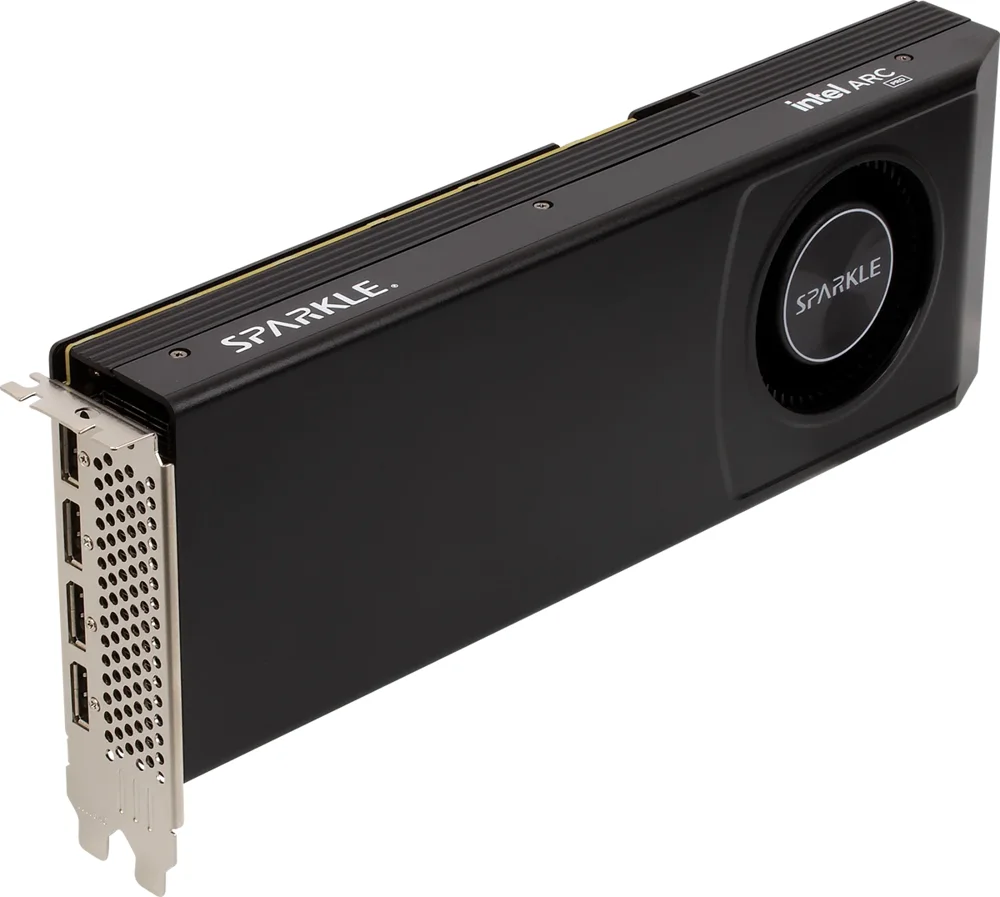
Overview
The Sparkle Arc Pro B60 24GB Blower is a partner card for Intel’s Arc Pro B60. Intel itself does not sell the B60 under its own name, but only through manufacturers like Sparkle, ASRock, Gunnir, or Maxsun. In Japan, the card went on sale on November 21, 2025. Sparkle announced the worldwide launch through retailers like Newegg and Micro Center on January 12, 2026, with a suggested retail price of US$799.
The card is intended for workstations and servers where several graphics cards are packed closely together. That is what the blower cooler is for: a radial fan draws in air and pushes it directly out of the case through the slot bracket. The warm air does not heat up the neighboring card. In Intel’s lineup, the B60 sits between the small B50 with 16 GB and the larger B65 and B70 with 32 GB.
What it brings to AI
24 GB of VRAM is the real reason for this card. As a rule of thumb, a language model reduced to 4 bits (quantized) needs about 0.6 GB per billion parameters, plus buffer space for context. That means models up to roughly 30 billion parameters fit in 24 GB, for example Qwen3 with 30 to 32 billion parameters at short to medium context lengths. Smaller models up to 14 billion parameters run with plenty of room for long texts.
The 456 GB/s bandwidth determines the speed when generating text. For each new token, the entire model has to be read once. An 18 GB model can therefore theoretically reach at most about 25 tokens per second, and a bit less in practice. Mixture-of-Experts (MoE) models are faster because only part of the model is active for each token.
Its strength lies in multi-GPU operation. Intel and the vLLM team show runs with four and eight B60 cards. With four cards, you get 96 GB, enough for gpt-oss-120b. According to Intel’s vLLM blog, a system with four B60 cards reaches around 1,500 tokens/s total throughput with 100 simultaneous requests for gpt-oss-120b. For a single user, the speed is much lower. Sparkle also advertises its own switch boards for 2, 4, 8, or 16 cards in the server.
Technical details
The board uses Intel’s BMG-G21 chip in its full configuration with 20 Xe cores and 160 XMX units. XMX are matrix compute units for AI, similar to NVIDIA’s Tensor cores. Intel lists 197 TOPS at INT8. PCGH describes the card as technically closely related to the Arc B580 gaming card, just with twice as much memory.
The memory is connected via a 192-bit bus. The card fits mechanically into an x16 slot, but electrically uses only eight PCIe 5.0 lanes. That is usually not a problem for inference. However, on a PCIe 4.0 board the transfer rate is cut in half, which costs a bit of time when loading large models and in multi-GPU operation.
Power comes through an 8-pin connector, and Sparkle rates power draw at 200 W. PCGH measured 33 to 37 W at idle and up to 162 W in games. Under sustained load, the chip stayed around 60 °C, and the fan spun at up to about 3,200 rpm. PCGH describes the noise as loud, but more pleasant than on some older cards.
The card is 289 mm long, 120 mm high, and takes up two slots. On the back, there are four DisplayPort 2.1 outputs. Intel offers professional drivers with certifications for CAD applications, but you can also use the regular gaming drivers.
Who is it for?
The card is worth it if you want a lot of VRAM for the money and want to run models up to about 30 billion parameters locally. It is especially useful if you plan to upgrade later to two, four, or more cards. Thanks to the blower cooler, several cards fit directly next to each other, as long as the power supply and motherboard cooperate. Anyone working under Linux with vLLM will benefit the most.
Limitations
Software support is the biggest downside. Many AI tools rely on NVIDIA’s CUDA. For Intel, you need oneAPI, SYCL, Vulkan, or Intel’s own vLLM containers (LLM Scaler). That works, but it takes more tinkering. In its B70 test, StorageReview describes Intel’s vLLM branch as still beta quality with a limited model selection.
A blower fan is inherently louder than a large axial cooler. That is something to keep in mind for a PC sitting next to your desk. The price varies a lot: Sparkle lists US$799, the expected price in Japan was ¥119,800, and PCGH cites around €900.
The connection with only eight lanes can slow things down in multi-GPU systems with PCIe 4.0.
Alternatives
- Gunnir Arc Pro B60 TF 24G: same chip, also with a radial fan, slightly shorter, but with two 8-pin connectors.
- Intel Arc Pro B65: 32 GB and 608 GB/s, so more room and more speed with the same number of Xe cores.
- Maxsun Arc Pro B60 Dual 48G Turbo: two B60 chips on one card, but it needs a motherboard with x8/x8 bifurcation.
This report is based on manufacturer information and published tests; we did not test the device ourselves.

