Overview
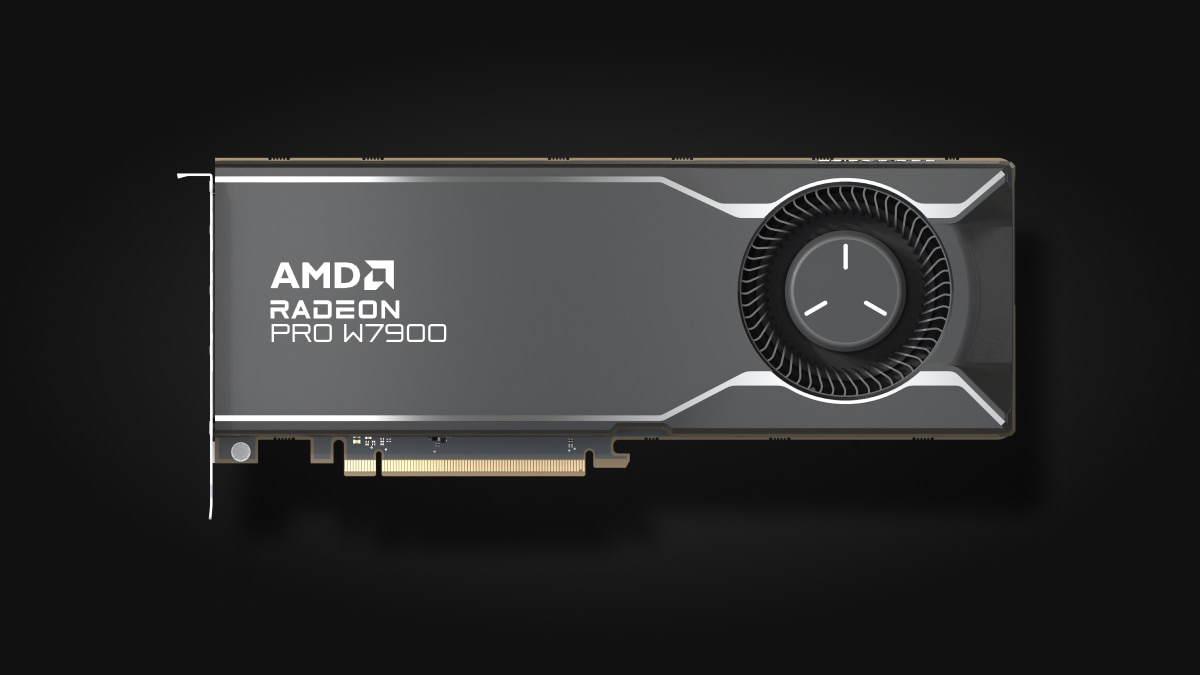
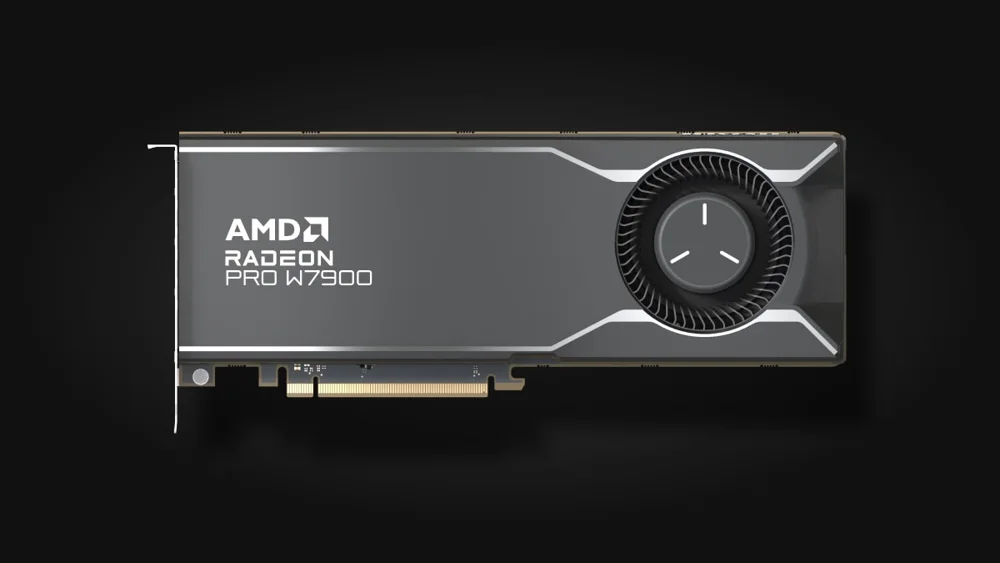
The Radeon PRO W7900 is AMD’s large workstation graphics card from the RDNA 3 generation. AMD introduced it on April 13, 2023, with a suggested price of US$3,999. It was originally meant for 3D design, rendering, and video editing. For local AI, it became interesting because it offers 48 GB of VRAM with error correction (ECC).
Important for context: This page describes the original W7900 with three-slot width. In 2024, AMD added a W7900 Dual Slot, with two slots and, according to Notebookcheck, $500 cheaper. The next generation for AI is the Radeon AI PRO R9700 with RDNA 4 and 32 GB.
What it brings for AI
48 GB of VRAM is the main reason for this card. As a rule of thumb, a language model with 4-bit quantization, meaning compressed weights, needs about 0.6 GB per billion parameters, plus buffer space for the context. A 32-billion-parameter model takes up about 19 GB this way and leaves plenty of room for long texts. A 70-billion-parameter model comes to about 42 GB and still just fits on one card, though with little buffer left for context. That does not work on 32 GB cards.
The memory bandwidth of 864 GB/s according to AMD is higher than on the newer R9700 with 640 GB/s. Since roughly the whole model has to be read for every word generated, the theoretical upper limit for a 42 GB model is around 20 tokens per second. In reality, it is less.
In terms of AI compute, the W7900 is older. Phoronix tested it against the R9700 in 2025: in the vLLM tests under ROCm 7.0, the R9700 was 1.47 times as fast on average. According to Phoronix, the W7900 also ran hotter.
Hardware details
The Navi 31 chip is split into chiplets. A compute chiplet in 5 nm sits next to memory chiplets in 6 nm. 96 Compute Units contain 192 AI accelerators. AMD lists 123 TFLOPS for FP16 as matrix compute and 245 TOPS in INT4. AMD does not provide FP8 figures for this generation. Newer models that use FP8 therefore do not benefit from this acceleration.
The memory is GDDR6 on a 384-bit bus with 96 MB of Infinity Cache. According to AMD, ECC is included, unlike the R9700 without restrictions on Linux. The card connects via PCIe 4.0 x16.
The card is 280 mm long and three slots wide. Cooling is handled by a blower-style fan that pushes heat out the back of the case. Power draw is 295 W according to AMD, and power comes from two classic 8-pin connectors. AMD recommends at least a 750 W power supply. For display outputs, there are three DisplayPort 2.1 ports and one Mini-DisplayPort.
Who is it for?
The W7900 is worth it if you want to run 70-billion-parameter models on a single card and do not want to use an NVIDIA card. It also makes sense if you need ECC or use the card for CAD and rendering at the same time. Used or on clearance, it can be interesting. At the original price, it is hard to recommend for AI work only.
Limitations
The price is the biggest drawback. For $3,999, you can buy three R9700 cards today with a total of 96 GB. Then there is the software: AI programs on Radeon run through AMD’s ROCm instead of NVIDIA’s CUDA. The W7900 is officially listed in AMD’s ROCm support list, and programs like llama.cpp and vLLM do run. But for new projects, you should expect more effort.
At three slots wide, you can hardly fit more than two cards in a normal PC. Anyone who wants to install multiple W7900 cards close together needs the dual-slot version. The missing FP8 support and PCIe 4.0 also show that the card is one generation older.
Alternatives
- AMD Radeon AI PRO R9700: 32 GB, newer, with FP8, faster according to Phoronix and much cheaper. For 70-billion-parameter models, though, you need two cards.
- GIGABYTE Radeon PRO W7900 Dual Slot AI TOP: the same 48 GB in two slots, better for systems with multiple cards.
- NVIDIA RTX PRO 5000 Blackwell: 48 GB with CUDA and a newer architecture, but priced within NVIDIA’s range.
This report is based on manufacturer information and published tests; we did not test the device ourselves.