Overview
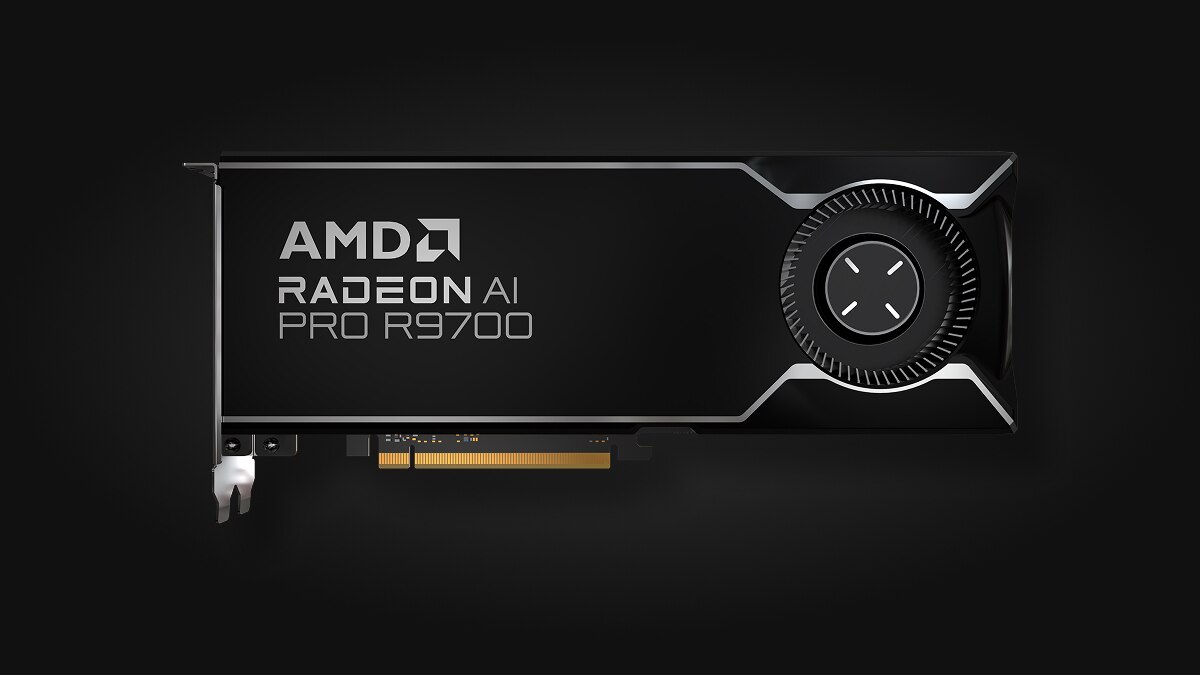
The Radeon AI PRO R9700 is AMD’s workstation graphics card for local AI. Technically, it uses the same graphics chip as the gaming card Radeon RX 9070 XT: a Navi 48 with RDNA 4 architecture. The important difference: instead of 16 GB, the R9700 has 32 GB of graphics memory. That is exactly the bottleneck for language models, not compute performance.
AMD presents the card as a reference design but does not sell it itself. On AMD’s site, the image explicitly says it is a representation that is not for sale. Retail versions come from partners such as ASRock, ASUS, GIGABYTE, PowerColor, Sapphire, and XFX. At first, the card was only available in complete systems. AMD announced the retail launch for October 27, 2025, with a suggested price of US$1,299. This page describes the specs that apply to all partner cards.
What it means for AI
32 GB of graphics memory (VRAM) determines which models can run entirely on the card. As a rule of thumb, a language model with 4-bit quantization, meaning heavily compressed weights, needs about 0.6 GB per billion parameters, plus buffer space for context. A model with 14 billion parameters uses about 8.5 GB, one with 32 billion about 19 GB. Both fit with plenty of room for long texts. A 70-billion model needs about 42 GB and no longer fits on one card, but it does fit on two cards with 64 GB total.
For response speed, memory bandwidth matters most. According to AMD, it is 640 GB/s. Since each generated word roughly means reading the whole model once, a 19-GB model gives a theoretical upper limit of just over 30 tokens per second. In practice, the value is lower.
Phoronix tested the card at launch under Linux with ROCm 7.0, both as a single card and in a dual-card setup. In vLLM tests, the R9700 averaged 1.47 times the older Radeon PRO W7900. Two R9700 cards were just ahead of a single NVIDIA RTX 6000 Ada. Phoronix measured average power draw at around 190 W, with peaks of around 300 W.
Specs in detail
The 64 Compute Units include 128 AI accelerators. These are compute units for matrix calculations, which constantly occur in neural networks. New compared with the previous generation is support for FP8, an 8-bit number format used by many current models. AMD lists 383 TFLOPS in FP8 and 766 TOPS in INT4, both without sparsity. The often cited 1,531 TOPS only applies with “Structured Sparsity,” a trick where part of the weights is deliberately set to zero. Real-world models rarely use that.
The memory is GDDR6 on a 256-bit bus, supplemented by 64 MB Infinity Cache. ECC, meaning error correction in memory, is available according to AMD only under Linux. The card connects via PCIe 5.0 x16.
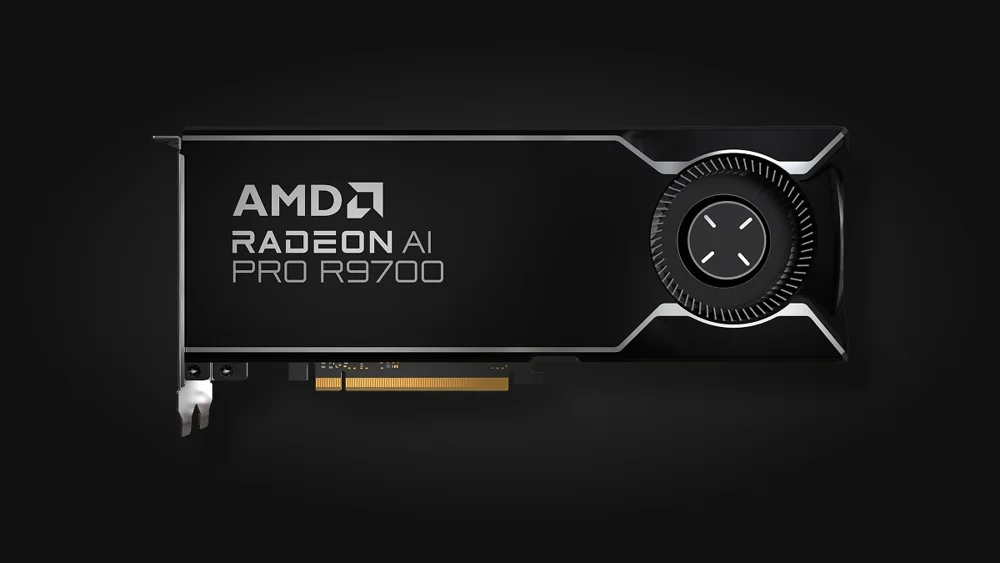
The reference design is two slots wide and uses a radial fan. Such a blower pushes the warm air out the back of the case instead of into the case. That makes it easier to install multiple cards side by side. Power comes through a 12V-2x6 connector, and AMD recommends at least a 750 W power supply.
Who is it for?
The R9700 is a good fit if you want to run language models up to about 32 billion parameters locally and need more than 24 GB, without moving into the price range of NVIDIA’s professional cards. It also makes sense if you plan a system with two to four cards. Because of the blower and the two-slot design, that is easier than with thick gaming cards. If you mainly work under Linux, Phoronix says you get good support right out of the box.
Limitations
The biggest hurdle is software. Many AI tools are built for NVIDIA’s CUDA first. AMD’s counterpart is ROCm. The R9700 is officially on AMD’s ROCm list, and common programs like llama.cpp and vLLM run. But with new or specialized projects, you will more often have to deal with workarounds or waiting.
The 640 GB/s bandwidth is rather tight for a card with 32 GB. Large models may fit into memory, but they run more slowly than on cards with faster memory. A blower is also usually louder under load than a cooler with large axial fans. And at 300 W per card, systems with multiple R9700s need a strong power supply.
The “AI” in the name is not just a label: the real advantage over the RX 9070 XT is the doubled memory, and that really matters for AI.
Alternatives
- AMD Radeon PRO W7900: 48 GB and 864 GB/s according to AMD, so even 70-billion models fit on one card. But it is older, without FP8, and much more expensive.
- NVIDIA RTX PRO 4500 Blackwell: also 32 GB, with CUDA and therefore the broadest software support, but at a higher price.
- Intel Arc Pro B70: also 32 GB, cheaper, but with Intel’s oneAPI ecosystem, which is still less common than ROCm.
This report is based on manufacturer information and published tests; we did not test the device ourselves.