
Overview
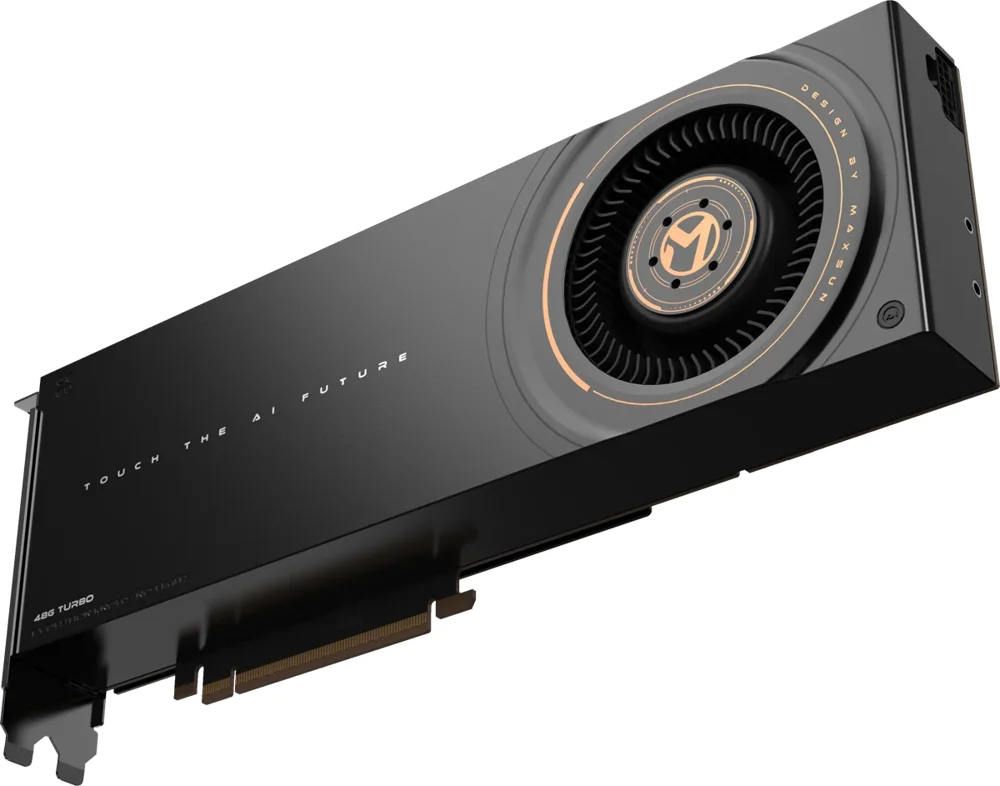
The Maxsun Arc Pro B60 Dual 48G Turbo packs two Arc Pro B60 graphics chips onto a single card. Maxsun introduced it at Computex in May 2025; in mid-August 2025, Guru3D reported its market launch at US$1,200. In Germany, the retailer GameMachines listed it, according to PCGH, starting on August 23, 2025 for €1,499.
The idea: Two cards with 24 GB each usually need two slots and take up four slots of space. The dual card does the same in one slot and two slots of width. That means a motherboard with four x16 slots can fit up to eight B60 chips. It is cooled by a radial fan (blower) that exhausts the heat out the back of the case. There is also a liquid-cooled version (Dual 48G Liquid).
What it means for AI
Important up front: The 48 GB are not shared memory. The system sees two separate graphics cards with 24 GB each. A model larger than 24 GB has to be split across both chips by the software. vLLM does this with tensor or pipeline parallelism, llama.cpp with its multi-GPU split.
As a rule of thumb, a 4-bit reduced (quantized) language model needs about 0.6 GB per billion parameters, plus buffers for context. On one chip, that covers models up to roughly 30 billion parameters. Spread across both chips, models up to about 60 to 70 billion parameters are possible. But a 70-billion-parameter model at 4-bit already needs around 42 GB. That leaves little room for long context. Maxsun itself names DeepSeek R1 70B and QwQ 32B as examples.
Each chip has 456 GB/s of bandwidth. When a model is split, each chip only reads its half, which helps speed. In return, the chips have to exchange intermediate results over PCIe; there is no fast direct link like NVLink. One user in the vLLM forum reports that with two B60 cards and very long context, time to first answer becomes very long. A helper in the thread attributes this to PCIe data exchange. That is a single report, but a typical issue with this design.
We could not find an independent measurement of the Maxsun card with language models.
Details
Each of the two BMG-G21 chips has 20 Xe cores, 160 XMX units (matrix computing units for AI), and 24 GB of GDDR6 on a 192-bit bus. Maxsun lists 2,400 MHz and 197 TOPS at INT8 per chip. These are Intel reference values; there is no factory overclock.
The sticking point is connectivity. A B60 chip can only use eight PCIe lanes. The card therefore splits the x16 slot into two sets of eight lanes. This only works if your motherboard supports "bifurcation" at the slot with x8/x8. Many workstation and server boards can do this; many gaming boards cannot, or only on the first slot. Without this feature, the card cannot connect both chips as intended.
Power comes through a 12V-2x6 connector, and Maxsun lists 400 W power draw. According to PCGH and Guru3D, the value can be set between 250 and 400 W. The card is 300 mm long and two slots thick. Each chip has its own DisplayPort 2.1 and HDMI 2.1a output.
Who is it for?
The card is aimed at anyone who wants to fit as much graphics memory as possible into a small space. For example, for an AI server with four slots and up to 192 GB of graphics memory. It makes sense if you work under Linux with vLLM and serve multiple users or services. Important: You need a motherboard with x8/x8 bifurcation and a strong power supply.
Limitations
The bifurcation requirement is the biggest hurdle. Check your motherboard manual before buying.
Two separate memory pools are not as convenient as one card with 48 GB in a single block. The software has to split the model, and that costs speed. Intel’s software stack of oneAPI, SYCL, Vulkan, and its own vLLM containers is less mature than NVIDIA’s CUDA. In StorageReview’s test of the B70, Intel’s vLLM branch is described as beta quality.
400 W across two slots creates a lot of heat, and the blower is expected to be loud under load. We did not find measurements for that. There were major price differences: Guru3D lists US$1,200, while PCGH reports US retailers at US$2,999.
Alternatives
- Sparkle Arc Pro B60 Dual 48GB Blower: the same idea, but only with HDMI outputs and 440 W according to the spec sheet.
- Two individual B60s, e.g. Sparkle 24GB Blower: no bifurcation requirement, but they need two slots.
- Intel Arc Pro B70: 32 GB in one block with 608 GB/s and more computing power on a single chip.
This report is based on manufacturer information and published tests; we did not test the device ourselves.
