Overview
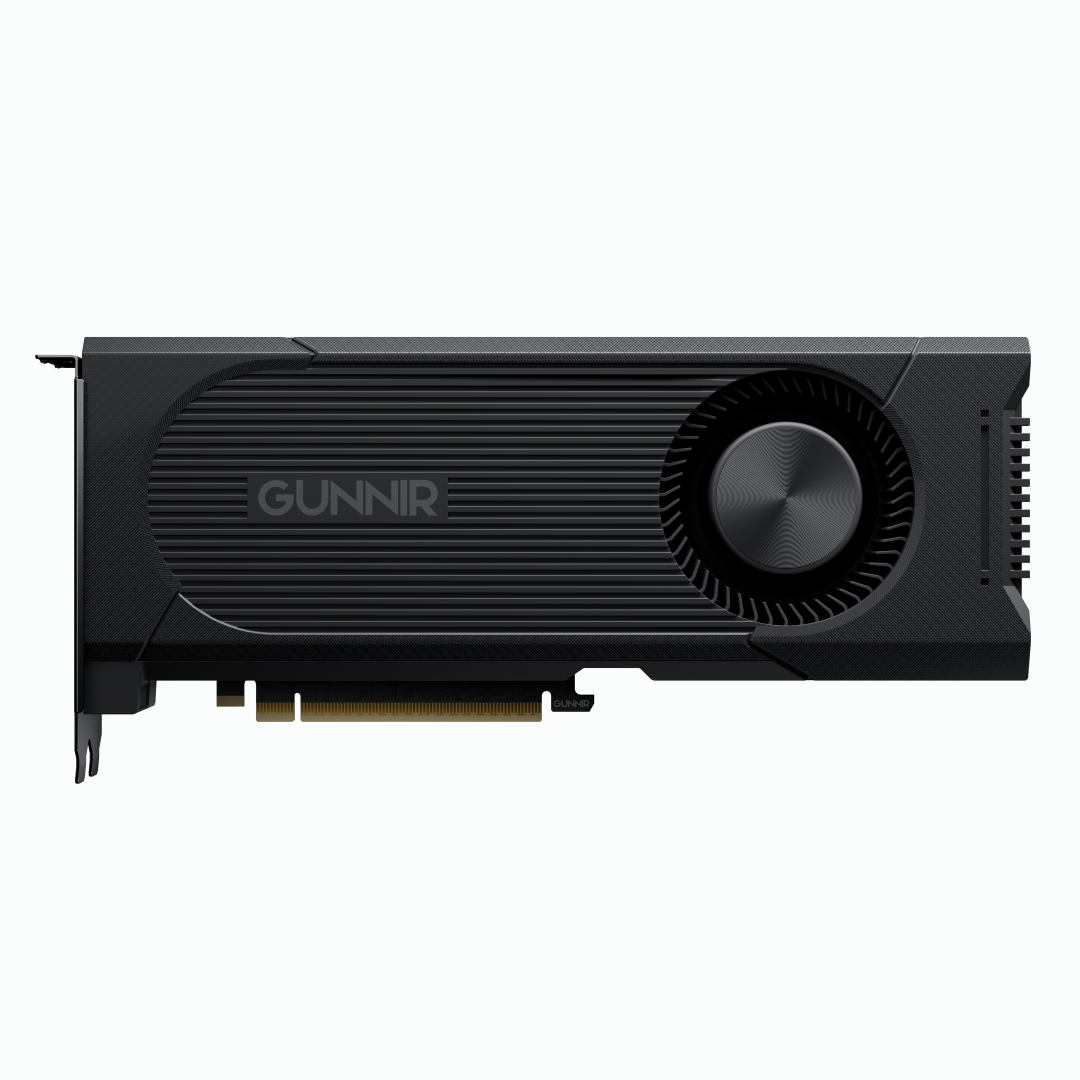
Gunnir is a Chinese graphics card brand whose current lineup consists of Intel Arc cards. In the “AI compute cards” category, Gunnir lists several Arc Pro B60 variants on its website. The most important one is the Arc Pro B60 TF 24G: a card with a radial fan, two slots thick, and full 200 W performance. There is also a fanless version for servers (BD) and, according to retailers and 3DNews, a single-slot, throttled version (BS). This report focuses mainly on the TF.
The Arc Pro B60 is Intel’s midrange professional graphics card. Intel does not sell it directly, only through partners like Gunnir, Sparkle, ASRock, or Maxsun. In the lineup, it sits between the B50 with 16 GB and the B65 and B70 with 32 GB.
What it means for AI
With 24 GB of VRAM, much larger language models fit than on typical gaming cards with 8 to 16 GB. As a rule of thumb, a 4-bit reduced (quantized) model needs about 0.6 GB per billion parameters, plus buffer space for context. That means 24 GB is enough for models up to roughly 30 billion parameters. 14-billion-parameter models run with plenty of room for long documents.
How fast the card writes depends on its memory bandwidth of 456 GB/s. For each new token, the model is read through once in full. An 18 GB model therefore tops out at around 25 tokens per second on paper, and less in practice. MoE models (Mixture of Experts), where only a small part computes each token, are much faster.
The B60 becomes interesting in a cluster. Intel and the vLLM team show systems with four and eight B60 cards. Four cards give you 96 GB, enough for very large models like gpt-oss-120b. According to Intel’s vLLM blog, such a system reaches around 1,500 tokens/s total throughput with gpt-oss-120b, split across 100 simultaneous requests. For a single user, the speed is much lower. Because the radial fan exhausts heat out the back of the case, the TF is well suited for such multi-card systems.
Specs in detail
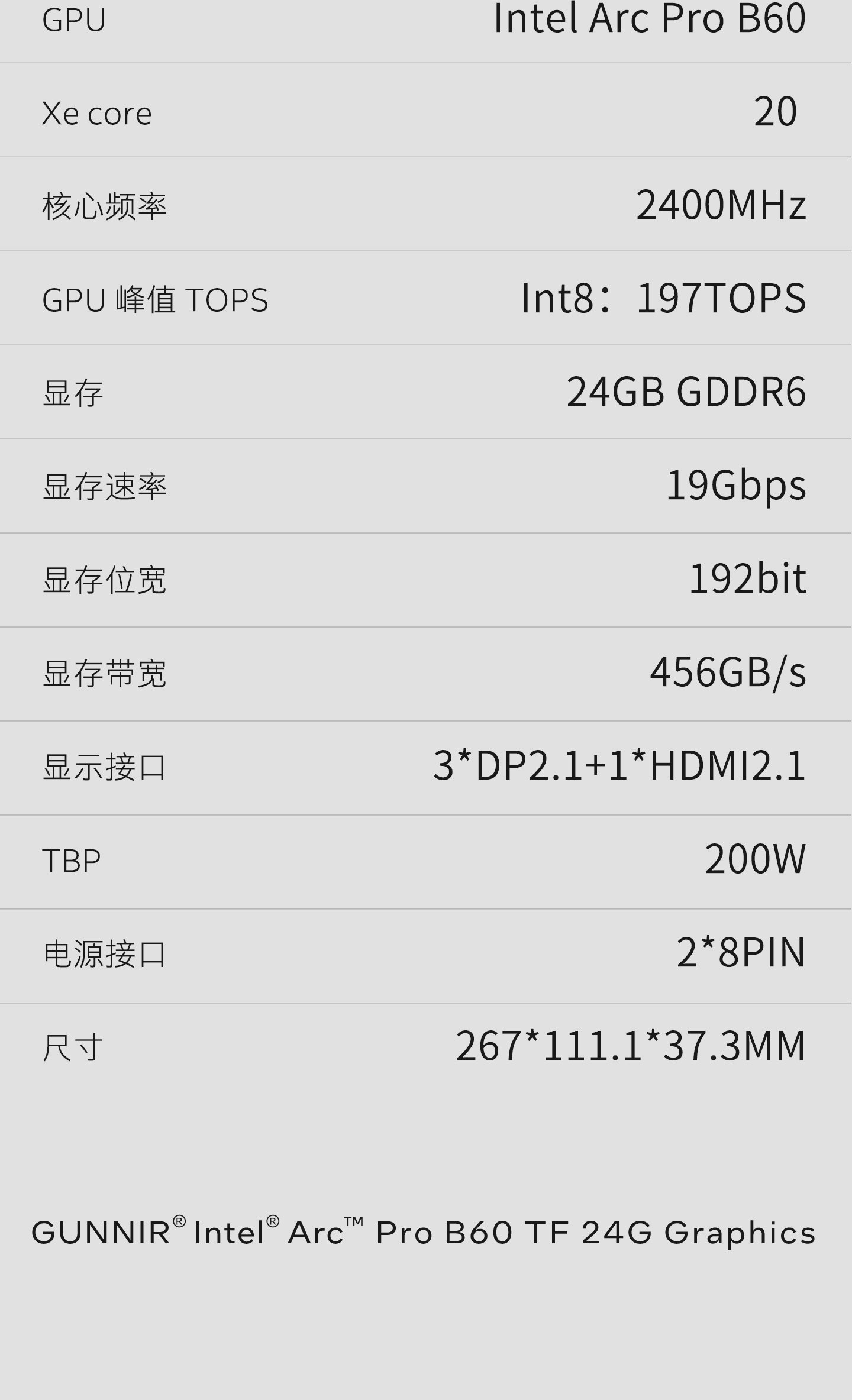
The card uses the BMG-G21 chip with 20 Xe cores and 160 XMX units. XMX are matrix compute units for AI, comparable to NVIDIA’s Tensor Cores. Gunnir lists 197 TOPS at INT8 and a 2,400 MHz clock, so Intel’s reference values.
The memory runs at 19 Gbit/s on a 192-bit bus. The card fits in an x16 slot, but electrically uses only eight PCIe 5.0 lanes. In a PCIe 4.0 system, throughput is cut in half. For inference with one card, that is rarely a problem; in multi-GPU setups, it can become a bottleneck.
The TF is a bit shorter at 267 mm than the Sparkle blower card at 289 mm and a little slimmer at 37.3 mm. Power comes from two 8-pin connectors, even though Gunnir, like Intel, lists 200 W. For display outputs, Gunnir uses three DisplayPort 2.1 ports and one HDMI 2.1 port.
The single-slot BS variant, according to 3DNews, is limited by Intel to 120 W and 2,000 MHz. AI performance drops to 164 TOPS. In China, it cost 5,199 yuan according to 3DNews, about US$745. For very dense servers with many cards, this version can be interesting.
Who is it for?
The Gunnir B60 TF is a fit for you if you want a lot of VRAM at a moderate price and want to run models up to about 30 billion parameters locally. It also works well as a building block for a Linux system with two or four cards. If you work with vLLM, OpenVINO, or llama.cpp via SYCL or Vulkan, you can make good use of the card.
Limitations
Gunnir is hardly available in Germany. The official website is only in Chinese, and the spec sheets are images. Warranty and support outside China go through retailers, which can be inconvenient. We could not find an official dollar or euro price.
Software is the biggest difference from NVIDIA. Many AI programs are written for CUDA. With Intel, you need oneAPI, SYCL, Vulkan, or Intel’s own vLLM containers. That works, but it takes more learning, and not every quantization or every model is supported equally well.
A radial fan is noticeably louder under load than a large axial cooler. We could not find noise measurements for this Gunnir card. And the two 8-pin connectors require a power supply with enough cables, especially with multiple cards.
Alternatives
- Sparkle Arc Pro B60 24GB Blower: same chip, only one 8-pin connector, easier to get in Europe.
- Intel Arc Pro B65: 32 GB and 608 GB/s, more room for larger models and longer context.
- Intel Arc Pro B70: 32 GB and 32 Xe cores, for anyone who needs more compute per card.
This report is based on manufacturer specifications and published tests; we did not test the device ourselves.