Overview
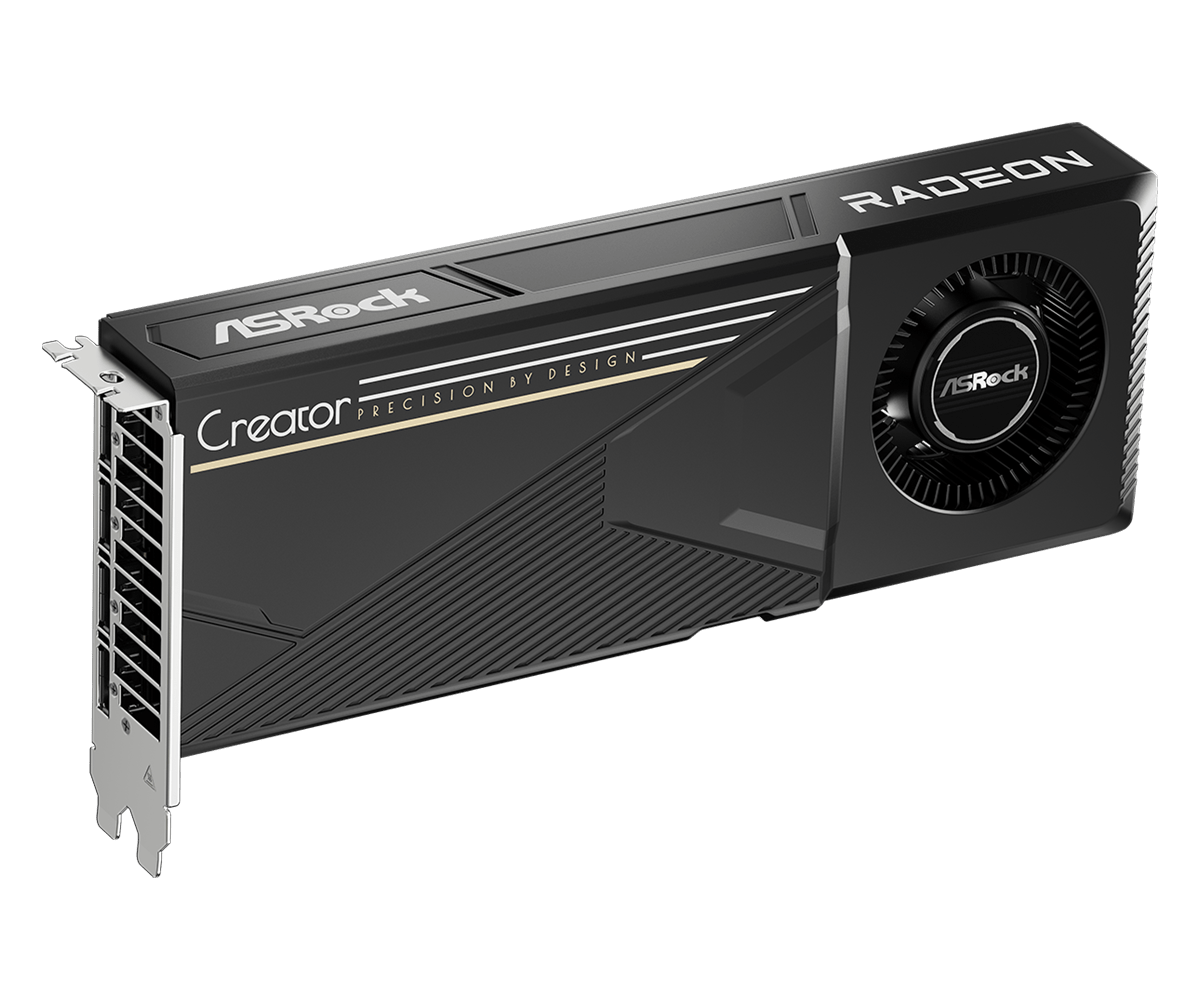
The ASRock Radeon AI PRO R9700 Creator 32G is ASRock's version of AMD's AI workstation card, the Radeon AI PRO R9700. ASRock unveiled it in June 2025 as the third card in the Creator line, after the RX 7900 XTX Creator and the RX 7900 XT Creator. Tom's Hardware describes it as a card based on AMD's reference design. In August 2025, Wccftech reported a listing at US retailer Newegg for US$1,329.
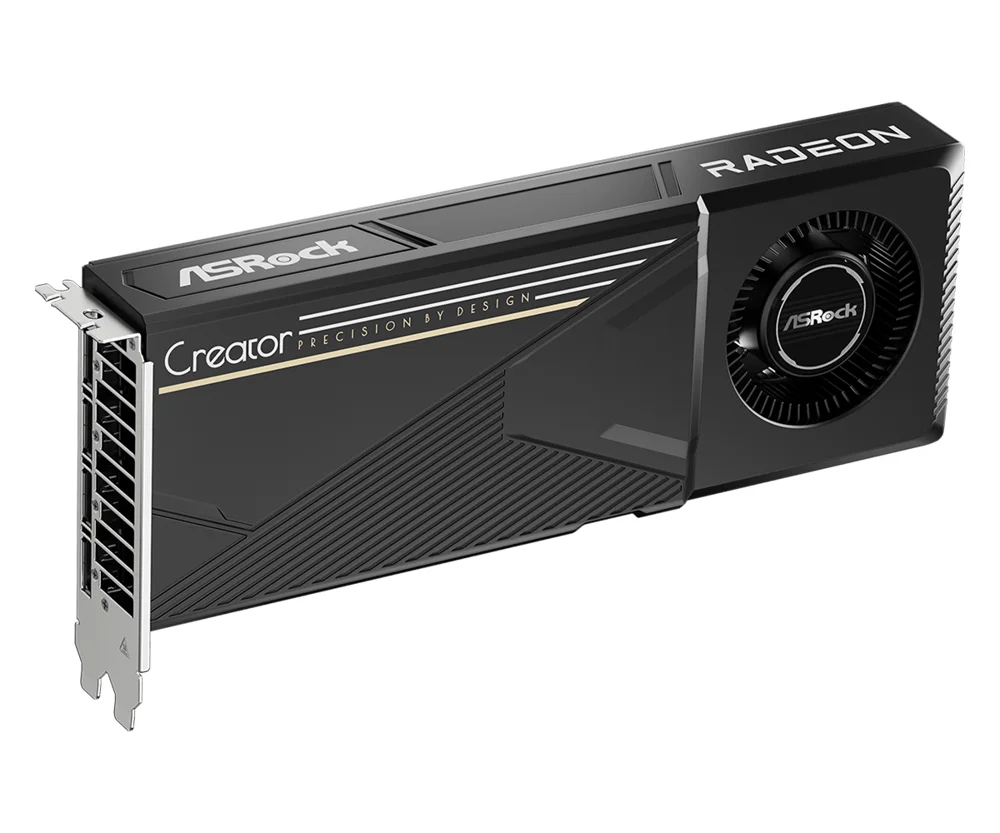
At its core, it's the same card as any R9700: a Navi 48 chip with RDNA 4 architecture, 4,096 stream processors, and 32 GB of GDDR6. ASRock uses a blower, a radial fan that pushes hot air out the back of the case, and a two-slot width.
What it brings for AI
VRAM determines which language models fit entirely on the card. As a rule of thumb, a model with 4-bit quantization, meaning compressed weights, needs about 0.6 GB per billion parameters. With 32 GB, models up to around 32 billion parameters (about 19 GB) run with plenty of room for long context. A 70-billion-parameter model needs around 42 GB and therefore a second card.
Club386 points out that up to four R9700 cards can be combined, giving you 128 GB of VRAM. The slim blower design is made for exactly that.
Speed depends mainly on memory bandwidth. According to AMD, it's 640 GB/s. For a 19 GB model, that works out to a theoretical maximum of just over 30 tokens per second. Phoronix measured the R9700 in vLLM under ROCm 7.0 at an average of 1.47 times a Radeon PRO W7900. The test used AMD's reference card; the Creator should perform similarly at the same clock speeds.
Hardware details
Under the die-cast metal shroud, Tom's Hardware says there is a vapor chamber. That's a flat, liquid-filled chamber that quickly spreads heat away from the chip. Between the chip and the cooler, ASRock uses Honeywell PTM7950. This thermal material softens with heat and is considered more durable than regular paste. Club386 also notes that the fan is slightly offset. That leaves a small opening for intake air even when the next card is installed right beside it.
Clock speeds match AMD's specs at 2,350 MHz (Game) and up to 2,920 MHz (Boost). The memory runs at 20 Gbit/s on a 256-bit bus.
Power comes through a single 12V-2x6 connector, the newer 16-pin standard. According to Tom's Hardware, ASRock recommends a power supply with at least 800 W, a bit more than AMD's 750 W. The card is 271 mm long. For the power cable, Tom's Hardware says to leave about 30 mm of extra space, because this connector does not bend tightly.
For display outputs, Club386 lists four DisplayPort 2.1a ports and no HDMI.
Who is it for?
The Creator is a good fit if you want to build an AI PC with two to four graphics cards and 32 GB per card is enough. It also makes sense if you run a workstation with multiple DisplayPort monitors. If you're only using one card, you can just go with the cheapest R9700 you can find. The chip is the same on all of them.
Limitations
Software is the biggest issue. AI programs on Radeon run through AMD's ROCm, not NVIDIA's CUDA. The R9700 is officially listed in AMD's ROCm support, and common tools like llama.cpp and vLLM work. But with new projects, you often have to expect workarounds.
A blower is usually louder under full load than a cooler with large axial fans. We couldn't find a noise test for the Creator. The 640 GB/s bandwidth is a bit tight for 32 GB, so large models run noticeably slower than on cards with faster memory. We don't know of an official MSRP from ASRock; the Newegg price of US$1,329 was slightly above AMD's suggested US$1,299.
Alternatives
- ASUS Turbo Radeon AI PRO R9700: the same GPU with a blower, metal backplate, and an additional HDMI port.
- AMD Radeon PRO W7900: 48 GB and higher bandwidth, so 70-billion-parameter models fit on one card, but it's older and significantly more expensive.
- NVIDIA RTX PRO 4500 Blackwell: also 32 GB, with CUDA and broader software support, but more expensive.
This report is based on manufacturer information and published tests; we did not test the device ourselves.